Critical care nursing moves fast, and so does the course that teaches it. You’re expected to interpret hemodynamic numbers, recognize a deteriorating patient before the monitor screams at you, and know exactly what to do with ventilators, drips, and complex equipment. There’s very little room for guessing in this specialty, and that pressure carries right over into how the exams are written.
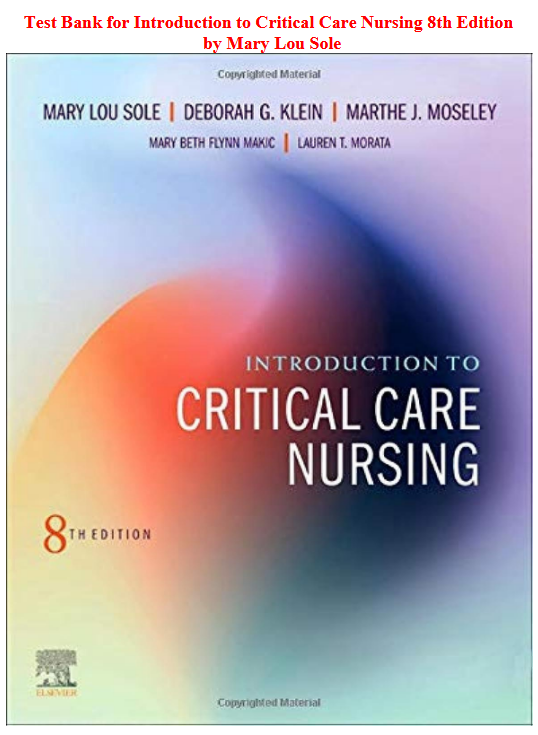
This test bank is built to help you meet that pressure with some actual preparation behind you. It follows the 8th edition of Introduction to Critical Care Nursing by Mary Lou Sole, Deborah Klein, and Marthe Moseley, chapter by chapter. Whatever system or complication you’re covering in class, there’s a matching set of practice questions ready for you.
This resource isn’t a substitute for time in simulation lab or clinical rotations. It’s a way to test whether the theory behind those skills has actually settled in. Reading about ventilator modes is one thing. Correctly identifying the right one in a scenario question is a different skill, and that’s exactly what repeated practice builds.
What Is a Test Bank?
A test bank is a large collection of practice questions built around a specific textbook. Instructors often draw from resources like this when writing their actual exams. That means studying with this test bank familiarizes you with the tone, structure, and difficulty level your real exam is likely to use.
This resource spans the full range of the 8th edition, including hemodynamic monitoring, mechanical ventilation, cardiovascular emergencies, shock states, neurological critical care, and the complex assessment and prioritization skills that critical care nursing depends on.
Why Nursing Students Use Test Banks for Critical Care Courses
Critical care exams tend to ask what you’d do right now, not just what a condition is called. A test bank helps train that kind of urgent, applied thinking. Here’s how.
You get sharper at recognizing subtle deterioration. Critical care questions often describe a set of trending vital signs and ask what’s happening before it becomes obvious. Practicing with similar questions trains you to catch those early patterns.
You find your weak spots before the exam does. Maybe cardiac emergencies feel solid, but ventilator settings still feel confusing. Practice questions point you straight to what needs more review.
You build confidence heading into the exam. The more familiar the question format feels, the calmer you’ll be when the real test starts. In a subject this high-stakes, staying calm actually helps you think more clearly.
You study more efficiently. Instead of flipping through dense chapters trying to guess what’s testable, the material is already organized and ready for review.
What’s Inside This Test Bank
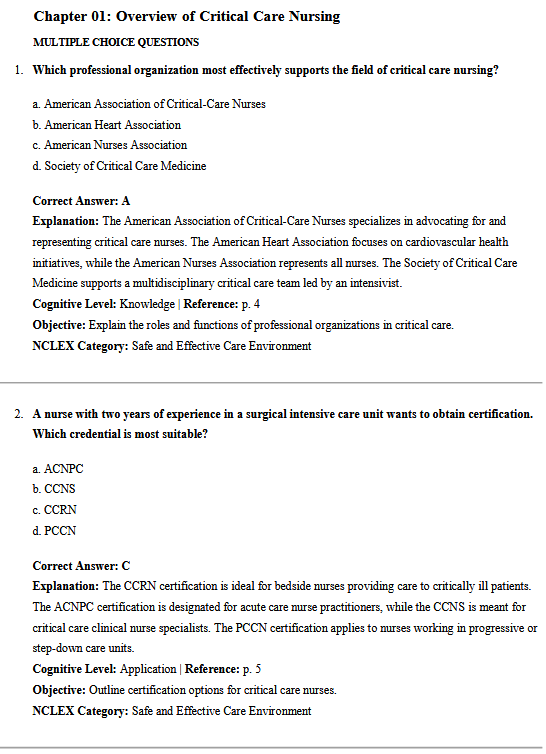
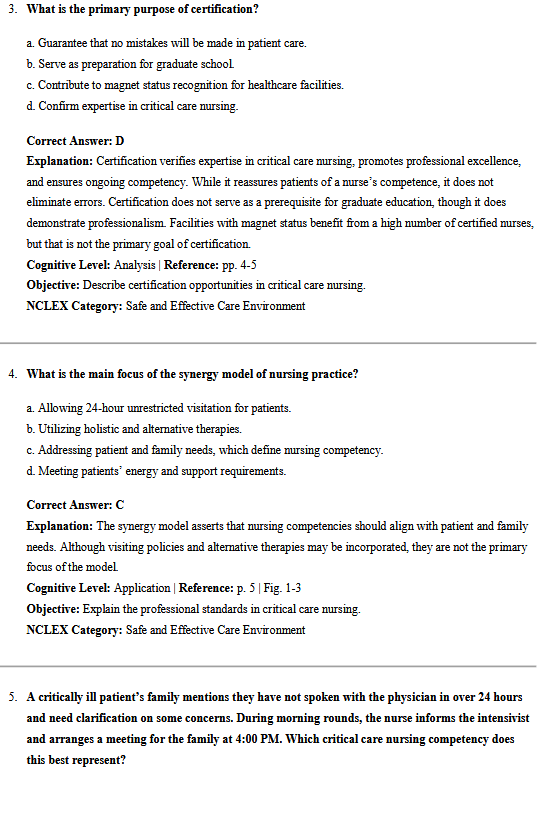
This resource includes multiple-choice questions organized by chapter, each with a correct answer and a rationale explaining why. The rationale is where the real learning happens. Critical care scenarios often present several plausible-sounding actions. Understanding why one intervention takes priority over another is what actually prepares you for real bedside decisions, not just for passing a test.
Topics covered include:
- Hemodynamic monitoring and interpretation
- Mechanical ventilation and airway management
- Shock states and their management
- Cardiovascular emergencies, including arrhythmias and acute coronary syndromes
- Neurological critical care and increased intracranial pressure
- Renal failure and continuous renal replacement therapy
- Sepsis recognition and management
- Multisystem organ dysfunction
- Critical care pharmacology and vasoactive drips
- Ethical and end-of-life considerations in critical care
Sample Questions
Here are five sample questions similar to what’s inside the full test bank. Try answering them before checking the rationale.
Question 1
A nurse is caring for a mechanically ventilated patient and notes a sudden increase in peak airway pressure along with decreased breath sounds on the left side. Which condition should the nurse suspect first?
A. Pulmonary edema
B. Pneumothorax
C. Ventilator disconnection
D. Mucus plug in the endotracheal tube
Correct Answer: B. Pneumothorax
Rationale: A sudden rise in peak airway pressure paired with decreased or absent breath sounds on one side strongly suggests a pneumothorax, which requires immediate attention. Pulmonary edema typically presents with crackles bilaterally rather than unilateral absent sounds. Ventilator disconnection would cause an alarm for low pressure, not increased pressure. A mucus plug can raise airway pressure but usually affects breath sounds more diffusely rather than causing a clear one-sided absence.
Question 2
A patient in septic shock has a blood pressure of 78/42 mmHg despite adequate fluid resuscitation. Which medication should the nurse anticipate administering next?
A. A diuretic
B. A vasopressor, such as norepinephrine
C. An antihistamine
D. A beta-blocker
Correct Answer: B. A vasopressor, such as norepinephrine
Rationale: When fluid resuscitation alone fails to correct hypotension in septic shock, a vasopressor like norepinephrine is used to increase vascular tone and blood pressure. A diuretic would worsen hypotension by reducing fluid volume. An antihistamine has no role in treating shock. A beta-blocker would further lower blood pressure and heart rate, worsening the patient’s condition.
Question 3
A patient with increased intracranial pressure has a Glasgow Coma Scale score that drops from 13 to 9 over the past hour. Which nursing action is the priority?
A. Document the change and reassess in four hours
B. Notify the healthcare provider immediately
C. Encourage the patient to rest quietly
D. Lower the head of the bed to improve comfort
Correct Answer: B. Notify the healthcare provider immediately
Rationale: A significant drop in Glasgow Coma Scale score indicates neurological deterioration and requires immediate provider notification for further evaluation and intervention. Waiting four hours to reassess delays urgent care. Encouraging rest doesn’t address the underlying neurological change. Lowering the head of the bed can worsen intracranial pressure rather than help it.
Question 4
A nurse is monitoring a patient’s pulmonary artery catheter readings and notes an elevated pulmonary capillary wedge pressure. Which condition does this finding most likely indicate?
A. Hypovolemia
B. Left ventricular failure
C. Right ventricular failure
D. Pulmonary embolism
Correct Answer: B. Left ventricular failure
Rationale: An elevated pulmonary capillary wedge pressure reflects increased pressure in the left atrium and ventricle, commonly seen in left ventricular failure as blood backs up into the pulmonary circulation. Hypovolemia would typically show a low wedge pressure due to reduced fluid volume. Right ventricular failure is more closely associated with elevated central venous pressure rather than wedge pressure. Pulmonary embolism can affect right-sided pressures more directly than left-sided wedge pressure in early stages.
Question 5
A patient receiving a continuous heparin infusion has an activated partial thromboplastin time (aPTT) significantly above the therapeutic range. Which action should the nurse anticipate?
A. Increasing the heparin infusion rate
B. Administering protamine sulfate
C. Discontinuing all anticoagulation permanently
D. Administering an additional heparin bolus
Correct Answer: B. Administering protamine sulfate
Rationale: Protamine sulfate is the reversal agent for heparin and is used when a patient’s aPTT is dangerously elevated above the therapeutic range, indicating excessive anticoagulation and bleeding risk. Increasing the infusion rate or giving an additional bolus would worsen the problem. Anticoagulation is often adjusted rather than stopped permanently, depending on the patient’s ongoing clinical need.
Who This Test Bank Is For
This resource fits nursing students taking a critical care nursing course, whether as part of a BSN program or a specialty critical care certificate track. It also supports certification exam preparation, such as the CCRN, since many core concepts overlap. Instructors may find it useful too, as a reference for building quizzes or exam material.
How to Study With This Test Bank
Don’t just read through the questions passively. Quiz yourself for real. Cover the answer choices, pick one, then check the rationale closely. Critical care questions often include several plausible-sounding actions, so slowing down to understand why one intervention takes priority is exactly the skill your real exam will test.
Working through one body system or complication at a time tends to work better than trying to cover everything in one sitting. Spacing your review out over several days helps keep complex hemodynamic and ventilator concepts from blurring together in your memory.
Instant Digital Access
This test bank is delivered as a digital file, so there’s no shipping wait. Once your order is complete, you can download it and start studying right away. It’s designed to work alongside your textbook and class notes, not replace either one.
Frequently Asked Questions
Is this the same as the textbook itself?
No. This is a test bank, meaning a collection of practice questions. It’s meant to be used together with the textbook, not instead of it.
Does every question include a rationale?
Yes. Each question comes with the correct answer along with a clear explanation of why that answer is right.
Will this help me prepare for the CCRN or similar certification exams?
It can. Many critical care concepts overlap with certification exam content, so this practice builds knowledge that carries over well beyond just one course.
Is this test bank matched to the 8th edition specifically?
Yes. The questions are organized to align with the chapters and content found in the 8th edition of Introduction to Critical Care Nursing by Sole.
How do I receive the file after purchasing?
You’ll get instant digital access right after checkout, so you can start studying immediately.
Can instructors use this resource too?
Yes. Instructors often use test banks as a reference when building quizzes, exams, or review sessions.
Is using a test bank considered cheating?
No, as long as it’s used for studying and practice rather than during an actual exam. Reviewing practice questions to strengthen understanding is a common and accepted study method among nursing students.


Faith B. –
Worth every penny
Favor –
Made studying much easier