Nursing education changed. Most programs moved away from memorizing disease after disease in isolation. Instead, they teach concepts that apply across dozens of conditions.
Perfusion. Oxygenation. Fluid and electrolyte balance. Cognition. Mobility. These concepts show up everywhere, in every specialty, with every patient population.
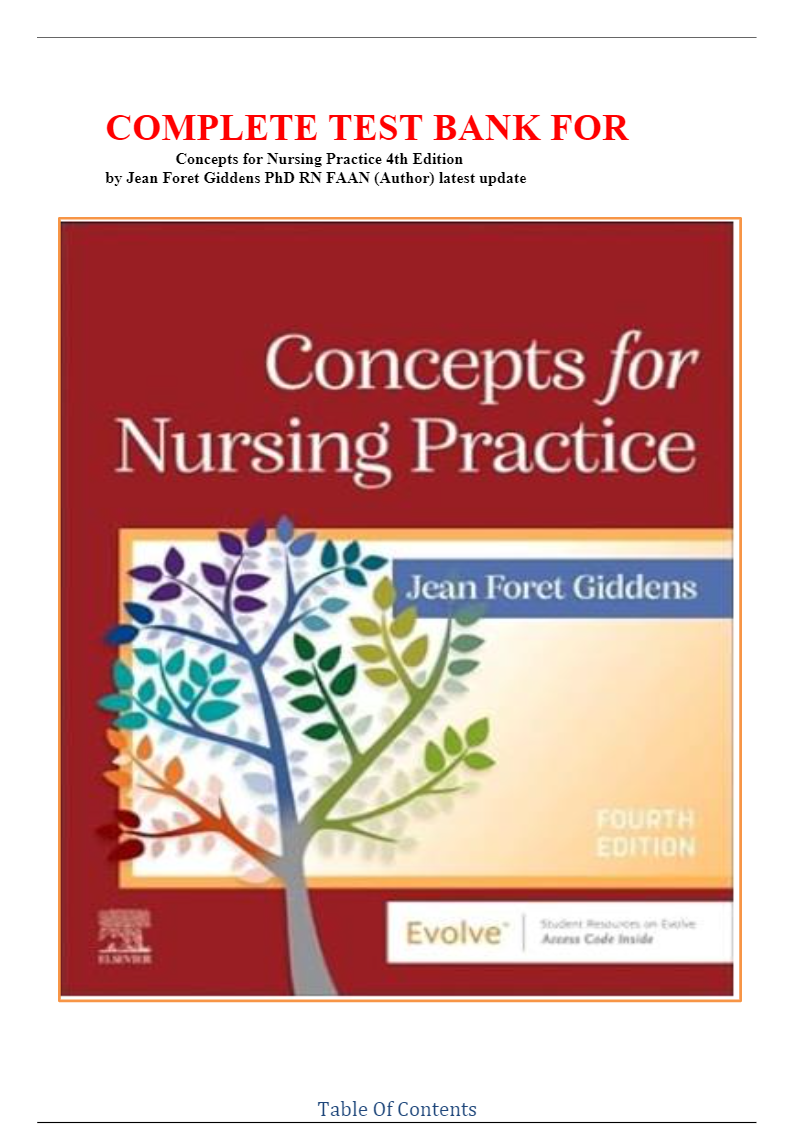
Giddens’ Concepts for Nursing Practice built this framework. And if your program uses it, you already know the exams test your ability to apply concepts across situations, not just recall isolated facts.
At Test Banks Hub, we built this test bank specifically around that concept-based approach. Every question is designed to test conceptual understanding, not memorization.
Why Concept-Based Learning Trips Up Students Used To Traditional Nursing Courses
Traditional nursing courses teach disease by disease. Learn diabetes. Learn heart failure. Learn pneumonia. Each one separate.
Concept-based courses flip that structure entirely.
- You learn “perfusion” once, then apply it to heart failure, shock, and peripheral vascular disease
- You learn “oxygenation” once, then apply it across respiratory and cardiac conditions
- Exemplars change, but the underlying concept stays constant
This approach makes sense once it clicks. Getting there is the hard part.
Students often struggle because:
- They’re used to studying diseases, not abstract concepts
- Questions require applying one concept across multiple, unrelated-seeming conditions
- The exemplar-based structure feels less concrete than traditional textbooks
- Interrelated concepts get confusing (how does mobility connect to tissue integrity?)
This test bank solves that problem directly. Repeated practice with concept-based questions builds the flexible thinking this approach demands.
What This Test Bank Covers
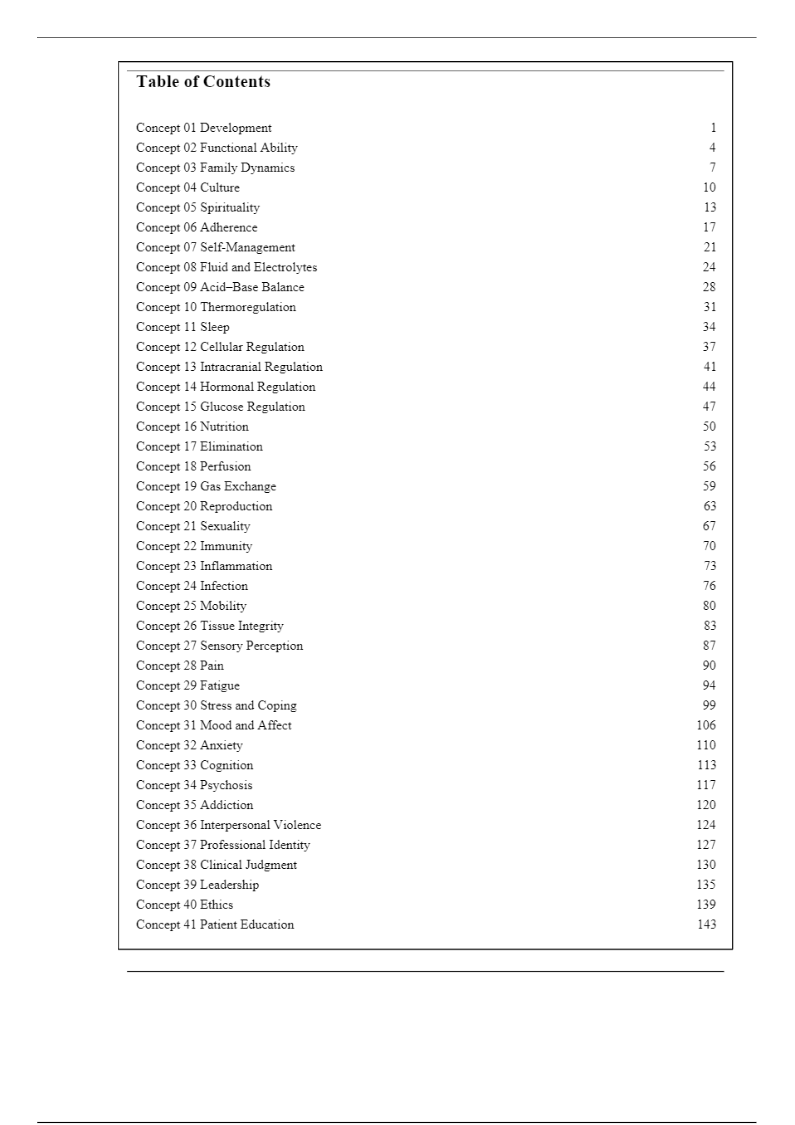
Every major concept category from the textbook receives full question coverage.
Individual Health Concepts
- Physiological concepts (perfusion, oxygenation, fluid/electrolyte balance, nutrition, elimination, mobility, thermoregulation)
- Psychological concepts (cognition, mood/affect, anxiety, stress/coping)
- Health, wellness, and illness concepts
Concepts Related to Health Care Recipients
- Development
- Culture
- Family dynamics
- Adherence
- Self-management
Concepts Related to the Health Care System
- Care coordination
- Safety
- Health care quality
- Health policy
- Technology and informatics
Concepts Related to Health Care Professionals
- Clinical judgment
- Communication
- Collaboration
- Professionalism
- Ethics
- Evidence-based practice
- Patient education
- Health promotion
Interrelated Concepts and Exemplars
- How multiple concepts overlap in real patient scenarios
- Application of concepts across different exemplar conditions
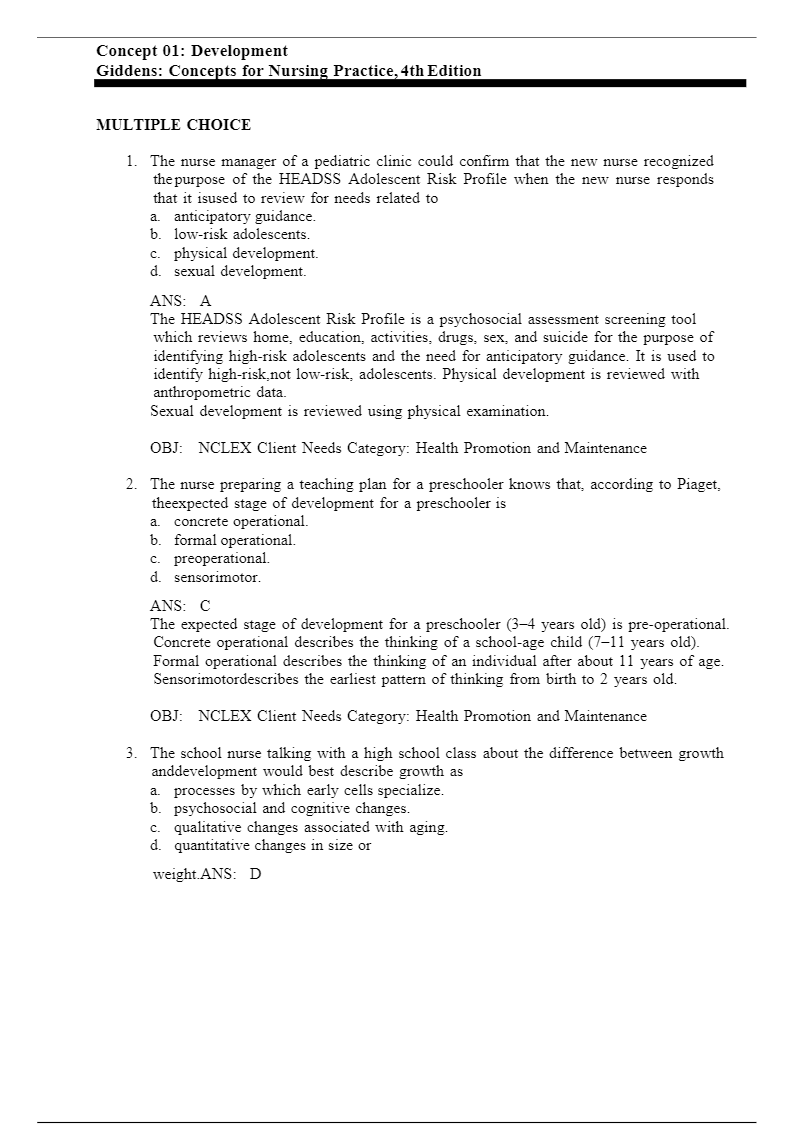
Every question includes a full rationale explaining how the concept applies within that specific clinical scenario. This connects the abstract framework to real, tangible patient care.
Question Formats You’ll Practice
- Multiple choice questions testing concept application
- Select-all-that-apply items covering interrelated concepts
- Scenario-based questions requiring concept identification
- Comparison questions linking concepts across different exemplars
This variety mirrors how concept-based exams are actually structured.
Five Sample Questions From This Test Bank
Here’s a preview of what’s included.
Question 1
A patient with heart failure and a patient in septic shock both demonstrate impaired tissue perfusion, despite having completely different underlying diagnoses. This illustrates which core principle of concept-based learning?
A) Diseases must always be studied individually
B) A single concept can apply across multiple, unrelated exemplars
C) Perfusion only applies to cardiovascular conditions
D) Concepts replace the need to understand pathophysiology
Correct Answer: B
Rationale: Concept-based nursing education emphasizes that concepts like perfusion transcend specific diagnoses. Understanding perfusion as a concept allows nurses to recognize and respond to impaired perfusion regardless of the underlying cause.
Question 2
Which assessment finding best reflects the concept of impaired cognition in an older adult patient?
A) Reports of occasional forgetfulness that doesn’t affect daily function
B) Sudden onset confusion, disorientation, and inability to follow commands
C) Mild difficulty recalling names of acquaintances
D) Normal age-related changes in short-term memory
Correct Answer: B
Rationale: Sudden onset confusion and disorientation represent significant impairment in cognition, potentially indicating delirium, which requires immediate investigation. The other options reflect normal aging changes that don’t significantly impact function.
Question 3
A nurse is caring for a patient with limited health literacy who has been prescribed a new medication regimen. Which concept is most directly relevant to ensuring this patient’s safety?
A) Mobility
B) Patient education
C) Thermoregulation
D) Elimination
Correct Answer: B
Rationale: Patient education directly addresses ensuring patients understand their treatment plans, especially when health literacy barriers exist. Effective teaching strategies tailored to the patient’s understanding level are essential for medication safety.
Question 4
Which scenario best demonstrates the concept of care coordination?
A) A nurse administers medication according to the scheduled time
B) A nurse communicates with physical therapy, dietary, and social work to develop a unified discharge plan
C) A nurse documents vital signs in the electronic health record
D) A nurse independently decides to increase a patient’s activity level
Correct Answer: B
Rationale: Care coordination involves collaborating across disciplines to create a cohesive plan of care. This scenario reflects that concept directly by integrating multiple healthcare team members toward a shared goal.
Question 5
A patient recovering from abdominal surgery has not had a bowel movement in three days and reports abdominal distention. Which two concepts are most directly interrelated in this scenario?
A) Mobility and thermoregulation
B) Elimination and comfort
C) Cognition and communication
D) Culture and family dynamics
Correct Answer: B
Rationale: Postoperative constipation directly affects the concept of elimination, while the resulting abdominal distention and discomfort connect to the concept of comfort. Recognizing these interrelated concepts helps nurses address the root cause rather than just the symptom.
How To Study This Material Effectively
Concept-based learning requires a different study approach than traditional memorization.
Study concepts, not just exemplars.
Understand perfusion as a standalone concept before connecting it to heart failure or shock specifically.
Create concept maps.
Visually connect related concepts. How does mobility affect tissue integrity? How does nutrition affect wound healing? Drawing these relationships builds understanding.
Practice applying one concept to multiple conditions.
Pick “oxygenation” and identify how it applies to COPD, pneumonia, and anemia. This flexible application is exactly what exams test.
Group interrelated concepts together.
Many concepts naturally connect. Studying them in clusters, rather than isolation, mirrors how they appear in real patient scenarios.
Review rationales carefully.
Understanding why a specific concept applies to a scenario teaches you the reasoning pattern, not just the answer.
Who This Test Bank Is Built For
This resource works well for:
- BSN and ADN students in concept-based nursing programs
- Students specifically using Giddens’ Concepts for Nursing Practice textbook
- Nursing instructors building exam questions aligned with concept-based curricula
- Students transitioning from traditional to concept-based programs
Whether you’re working through individual concept chapters or preparing for comprehensive exams covering multiple concepts, this test bank adapts to your needs.
Why Students Choose Test Banks Hub
We build test banks that reinforce genuine understanding.
- Detailed rationales explaining concept application, not just correct answers
- Direct alignment with the 4th edition textbook structure
- Comprehensive coverage across all concept categories
- Instant digital access after purchase
- Affordable pricing for student budgets
Concept-based nursing education asks you to think differently than traditional disease-based courses. This test bank gives you the practice needed to build that flexible, transferable thinking.
Frequently Asked Questions
Is this test bank based on the actual Giddens 4th edition textbook?
Yes. Every question aligns with concepts, exemplars, and terminology found in Concepts for Nursing Practice, 4th Edition.
How is this different from a traditional medical-surgical test bank?
Traditional test banks organize questions by disease. This test bank organizes questions by concept, testing your ability to apply ideas like perfusion or mobility across multiple, unrelated conditions.
My program just switched to concept-based learning. Will this help me adjust?
Yes. Many students transitioning from traditional to concept-based curricula find this test bank helpful for understanding how to think in terms of concepts rather than isolated diseases.
Does this cover psychosocial concepts, or just physiological ones?
Both. You’ll find questions addressing physiological concepts like oxygenation alongside psychosocial concepts like anxiety, cognition, and family dynamics.
How is this test bank delivered after purchase?
You receive instant digital access immediately after checkout.
Will this help me on NCLEX, since NCLEX isn’t organized by concept?
Yes. While NCLEX doesn’t explicitly use concept-based categories, the underlying clinical judgment and application skills this test bank builds transfer directly to NCLEX-style scenario questions.
Does this test bank include interrelated concept questions?
Yes. Several questions specifically address how multiple concepts overlap within single patient scenarios, reflecting real clinical complexity.
How many questions are included?
The test bank includes several hundred questions spanning all major concept categories covered in the textbook.
Start Practicing Concept-Based Thinking Today
Concept-based nursing education requires flexible thinking. The ability to recognize a concept in one context and apply it confidently in a completely different scenario.
This test bank gives you that practice. Real scenarios. Detailed rationales connecting concepts to application. Complete alignment with your textbook.
Get instant access today and start building the conceptual understanding that modern nursing practice demands.


NurseLeo –
Perfect!
Bernice M. –
Worth every penny