Evidence-based practice sounds simple on paper. Use the best research to guide patient care. But once you’re actually in the middle of a course on it, things get a lot more layered. You’re expected to appraise studies, weigh levels of evidence, understand research designs, and figure out how to actually apply findings at the bedside. That’s a lot to juggle at once.
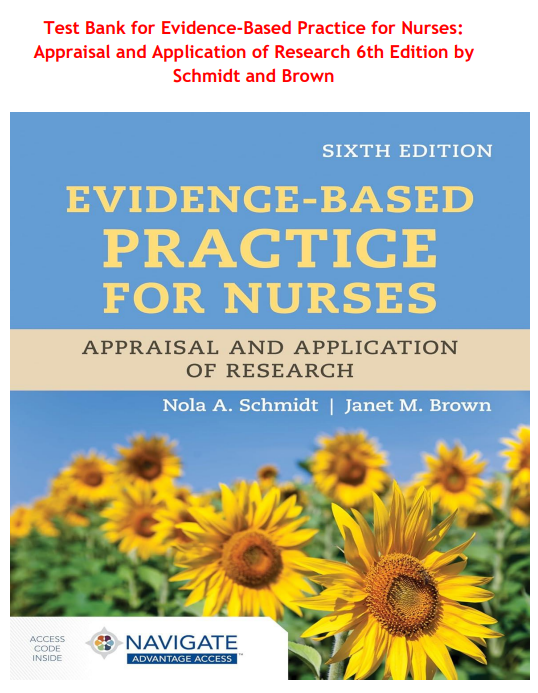
This test bank is built to help with exactly that. It follows the 6th edition of Evidence-Based Practice for Nurses: Appraisal and Application of Research by Nola A. Schmidt and Janet M. Brown, chapter by chapter. So whatever unit you’re working through in class, there’s a matching set of practice questions waiting for you.
This isn’t meant to replace your reading. It’s meant to sharpen it. Think of it like practice rounds before the real exam steps up to the plate.
What Is a Test Bank?
A test bank is a large collection of practice questions tied directly to a textbook. Instructors frequently pull from resources like this when writing actual course exams. That means when you study with this test bank, you’re training with the same style, tone, and difficulty level you’re likely to see on your real test.
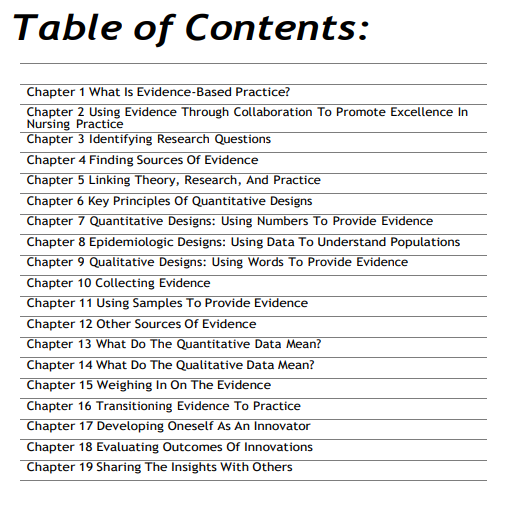
This resource covers the full scope of the 6th edition, including the fundamentals of evidence-based practice, research appraisal, levels of evidence, quantitative and qualitative research methods, and how to actually translate findings into clinical decisions.
Why Students Use Test Banks for This Course
Evidence-based practice courses ask you to think critically, not just memorize facts. A test bank helps build that skill through repetition and feedback. Here’s how.
You learn to catch subtle differences in wording. Terms like systematic review, meta-analysis, and clinical practice guideline get mixed up easily. Practicing with exam-style questions trains you to slow down and read each option carefully.
You find your weak areas faster. Maybe critical appraisal makes sense to you, but levels of evidence still feel blurry. Practice questions point you straight to what needs more review, instead of guessing where to focus.
You walk into the exam calmer. Familiarity with question style reduces exam-day anxiety. When the real test doesn’t feel unfamiliar, you think more clearly.
You study more efficiently. Instead of hunting through the textbook trying to predict what’s important, the key concepts are already organized and ready to review.
What This Test Bank Includes
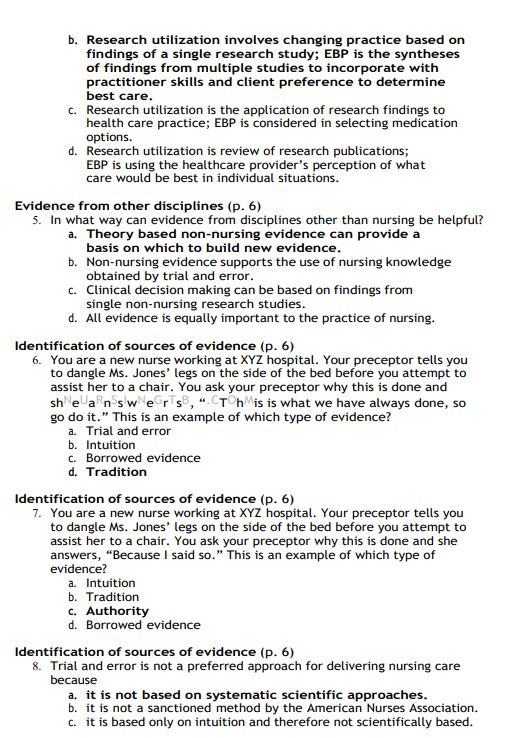
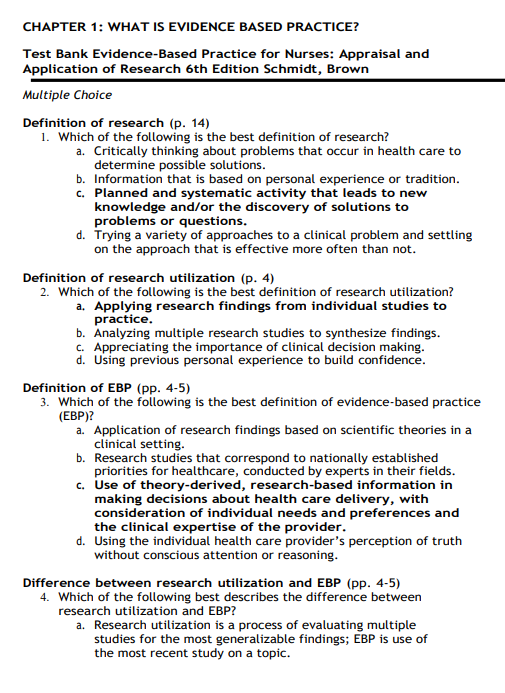
This resource contains multiple-choice questions organized by chapter, each with a correct answer and a rationale explaining why that answer is right. The rationale matters just as much as the answer itself. Memorizing “the answer is B” doesn’t help much if the real exam phrases the question differently. Understanding why B is correct is what actually transfers to new questions.
Topics covered include:
- Foundations and history of evidence-based practice
- Levels and hierarchies of evidence
- Formulating clinical questions (including PICO format)
- Searching and appraising research literature
- Quantitative research design and appraisal
- Qualitative research design and appraisal
- Systematic reviews and meta-analyses
- Translating evidence into clinical practice
- Barriers to implementing evidence-based practice
- Evaluating outcomes of practice changes
Sample Questions
Here are five sample questions similar to what’s inside the full test bank. Try answering them before checking the rationale.
Question 1
A nurse wants to find the best available evidence to guide a decision about wound care. Which resource provides the highest level of evidence?
A. Expert opinion
B. A single randomized controlled trial
C. A systematic review of multiple randomized controlled trials
D. A case report
Correct Answer: C. A systematic review of multiple randomized controlled trials
Rationale: Systematic reviews that combine multiple randomized controlled trials sit at the top of most evidence hierarchies because they synthesize findings across several rigorous studies. A single randomized controlled trial provides strong evidence but less than a synthesis of many. Expert opinion and case reports fall lower on the evidence hierarchy since they rely on individual experience rather than controlled research.
Question 2
A nurse is developing a clinical question using the PICO format. Which element represents the “C” in PICO?
A. Comparison
B. Condition
C. Consent
D. Criteria
Correct Answer: A. Comparison
Rationale: In the PICO format, C stands for comparison, referring to the alternative intervention or condition being compared against the intervention of interest. Condition, consent, and criteria are not part of the standard PICO framework, which stands for Population, Intervention, Comparison, and Outcome.
Question 3
A study followed the same group of patients over five years to observe how a risk factor related to disease development, without the researcher intervening. Which type of study is this?
A. Randomized controlled trial
B. Cohort study
C. Case-control study
D. Systematic review
Correct Answer: B. Cohort study
Rationale: A cohort study follows a group over time to observe outcomes related to an exposure or risk factor, without the researcher controlling the exposure. A randomized controlled trial involves active intervention and random assignment. A case-control study starts with an outcome and looks backward at exposure. A systematic review synthesizes multiple existing studies rather than following new participants.
Question 4
A hospital unit wants to implement a new evidence-based turning schedule to reduce pressure injuries. Which factor is most likely to act as a barrier to this change?
A. Strong research support for the new schedule
B. Staff resistance to changing established routines
C. Clear documentation guidelines
D. Support from nursing leadership
Correct Answer: B. Staff resistance to changing established routines
Rationale: Resistance to change is one of the most common and well-documented barriers to implementing evidence-based practice, even when the research supporting the change is strong. Strong research support, clear documentation, and leadership support are facilitators of successful implementation, not barriers.
Question 5
After implementing a new evidence-based protocol, a nurse manager tracks infection rates over the following six months. This action represents which step of the evidence-based practice process?
A. Formulating the clinical question
B. Searching for evidence
C. Appraising the evidence
D. Evaluating outcomes
Correct Answer: D. Evaluating outcomes
Rationale: Tracking results after a practice change has been implemented is the outcome evaluation step, which determines whether the change actually achieved the desired effect. Formulating the question, searching, and appraising evidence all happen earlier in the process, before a change is put into practice.
Who This Test Bank Is For
This resource works well for nursing students taking a course focused specifically on evidence-based practice or research appraisal. It also supports students preparing for exams that test critical appraisal skills, since evidence-based practice concepts show up across many nursing licensure and certification exams. Instructors may also find it useful as a quick source of quiz or exam questions.
How to Study With This Test Bank
Don’t just read through the questions passively. Actually quiz yourself. Cover the choices, pick an answer, then check the rationale. If you get one wrong, pause on it. Ask yourself what made the correct answer right and what made your choice wrong. That reflection is where real understanding builds.
Working through the material in smaller sessions, chapter by chapter, tends to work better than cramming everything the night before an exam. Spacing your review out over several days helps the concepts actually stick.
Instant Digital Access
This test bank is delivered digitally, so there’s no shipping delay. Once your purchase goes through, you can download it right away and start studying immediately. It’s designed to be used alongside your textbook and class notes, not as a replacement for either.
Frequently Asked Questions
Is this the same as the actual textbook?
No. This is a test bank, meaning a set of practice questions. It’s meant to be used together with the textbook, not in place of it.
Does every question come with a rationale?
Yes. Each question includes the correct answer along with an explanation of why that answer is correct.
Will this help me on licensure or certification exams?
It can. Evidence-based practice concepts appear on many nursing exams, so practicing this material builds knowledge that carries over well beyond just one course.
Is this test bank specific to the 6th edition?
Yes. The questions are organized to match the chapters and content of the 6th edition of Evidence-Based Practice for Nurses: Appraisal and Application of Research by Schmidt and Brown.
How do I get the file after purchasing?
You’ll get instant digital access right after checkout, so you can start using it right away.
Can instructors use this resource as well?
Yes. Instructors often use test banks as a reference when creating quizzes, exams, or review material for their classes.
Does using a test bank count as cheating?
No, as long as it’s used for studying and practice rather than during an actual exam itself. Using practice questions to build understanding is a common and accepted study method among nursing students.


Grace W. –
Really made my work easier
Lucille Maria –
Great
Warren Brent –
Exactly what I needed