

Geriatric patients don’t read the textbook.
Their symptoms present atypically. Their medications interact in complicated ways. Their conditions overlap until you’re managing five chronic diseases in one visit. Normal lab values shift with age. What looks like an emergency in a younger patient might be baseline for an 85-year-old.
Primary care geriatrics requires a completely different mindset than standard adult medicine. Ham’s textbook built its reputation on case-based learning specifically because geriatric care resists simple, isolated fact memorization.
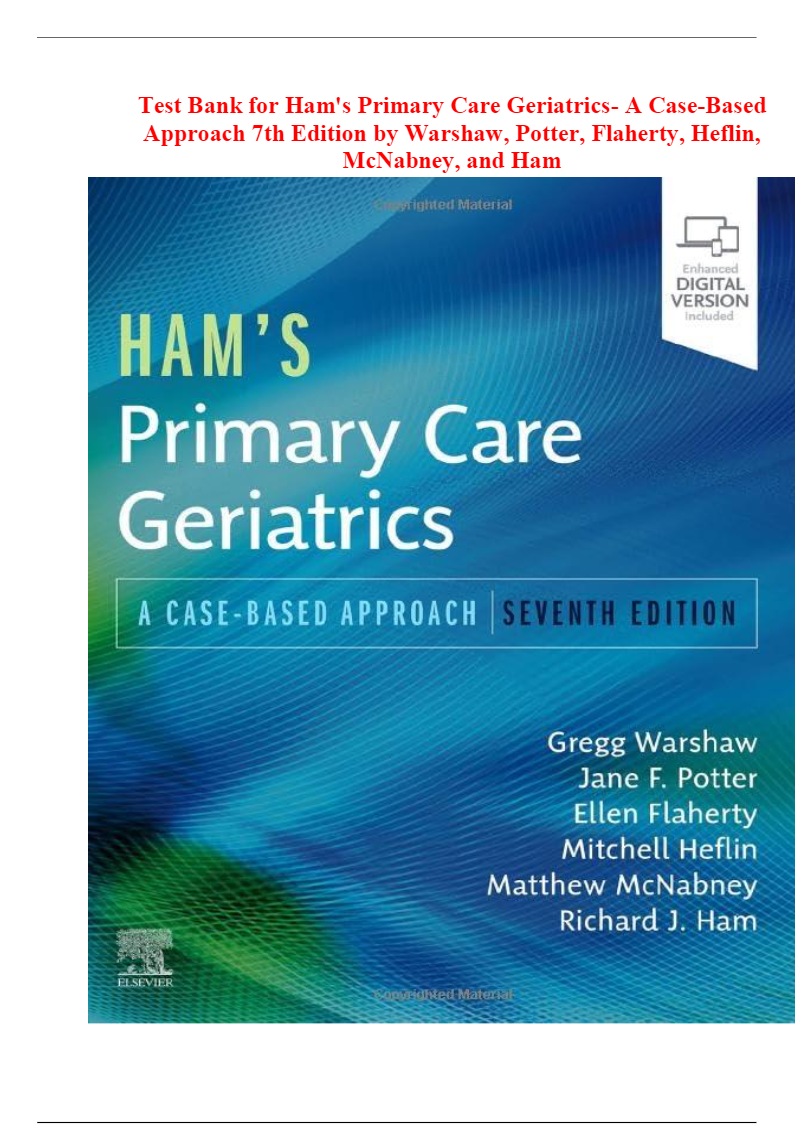
At Test Banks Hub, we built this test bank directly from the 7th edition, giving you structured practice applying geriatric principles to realistic clinical scenarios.
Why Geriatric Care Requires Different Thinking
Most medical and nursing education trains you to recognize textbook disease presentations.
Geriatrics throws that training out the window.
- Older adults often present atypically, sometimes with no fever despite serious infection
- Polypharmacy creates drug interactions most younger patients never experience
- Multiple chronic conditions interact, making single-diagnosis thinking dangerous
- Cognitive changes complicate history-taking and informed consent
- Functional status often matters more than diagnosis alone
- Normal aging changes must be distinguished from pathology
This test bank addresses these challenges directly. Case-based questions force you to think through geriatric complexity rather than applying standard adult medicine formulas that don’t fit this population.
What This Test Bank Covers
Every major content area from the textbook receives comprehensive question coverage.
Foundations of Geriatric Care
- Normal aging physiology versus pathology
- Comprehensive geriatric assessment
- Functional status evaluation
- Frailty recognition and management
Common Geriatric Syndromes
- Falls and mobility disorders
- Cognitive impairment and dementia
- Delirium recognition and management
- Urinary incontinence
- Polypharmacy and medication management
- Malnutrition and weight loss
Chronic Disease Management in Older Adults
- Cardiovascular disease considerations
- Diabetes management in elderly patients
- Osteoporosis and fracture prevention
- Chronic pain management
- Sensory impairment (vision and hearing)
Mental Health and Cognitive Issues
- Depression in older adults
- Anxiety disorders
- Dementia types and differentiation
- Behavioral and psychological symptoms
End-of-Life and Palliative Care
- Advance care planning
- Hospice and palliative care principles
- Goals of care discussions
- Ethical considerations in end-of-life decisions
Care Coordination and Systems Issues
- Transitions of care
- Long-term care settings
- Elder abuse recognition
- Caregiver support and burden
Preventive Care in Geriatrics
- Age-appropriate screening guidelines
- Immunizations for older adults
- Health promotion strategies
Every question includes a full rationale grounded in geriatric-specific reasoning. You’ll understand why standard adult medicine approaches often need modification for older patients.
Question Formats You’ll Practice
- Multiple choice questions testing geriatric-specific knowledge
- Case-based scenarios requiring integrated clinical reasoning
- Select-all-that-apply items covering multiple geriatric syndromes
- Priority questions addressing competing care needs
This format mirrors the case-based approach the textbook itself uses.
Five Sample Questions From This Test Bank
Here’s a preview of what’s included.
Question 1
An 82-year-old patient presents with new confusion, but no fever, and normal white blood cell count. Family reports she seemed fine yesterday. What should be the primary concern?
A) Normal age-related cognitive decline
B) Delirium secondary to an underlying acute cause
C) Early-stage dementia
D) Medication side effect that requires no further investigation
Correct Answer: B
Rationale: Acute onset confusion in a previously stable older adult suggests delirium, which often presents without classic signs like fever, especially in elderly patients. Delirium requires immediate investigation for underlying causes such as infection, medication effects, or metabolic disturbances, since it differs fundamentally from the gradual onset seen in dementia.
Question 2
Which finding is most important when assessing fall risk in an older adult during a routine visit?
A) Patient’s self-reported confidence in balance
B) Timed Up and Go test performance
C) Family history of falls
D) Patient’s age alone
Correct Answer: B
Rationale: The Timed Up and Go test provides an objective, standardized measure of mobility and fall risk. While self-report and history matter, objective functional testing offers more reliable data for clinical decision-making than subjective or purely demographic factors.
Question 3
An older adult taking multiple medications develops new dizziness and orthostatic hypotension. What is the most appropriate initial action?
A) Add a new medication to manage the dizziness
B) Review the complete medication list for potential contributing drugs
C) Assume this is a normal part of aging requiring no intervention
D) Refer immediately to cardiology without further primary care evaluation
Correct Answer: B
Rationale: Polypharmacy is a leading cause of orthostatic hypotension and dizziness in older adults. A thorough medication review often identifies the causative agent, such as antihypertensives or sedatives, allowing for appropriate adjustment before pursuing more invasive workup.
Question 4
Which statement best reflects appropriate diabetes management goals for a frail 88-year-old with limited life expectancy?
A) Strict glycemic control with HbA1c goal below 6.5%
B) Less stringent glycemic targets prioritizing avoidance of hypoglycemia
C) Discontinuing all diabetes medications regardless of glucose levels
D) Identical treatment goals as a healthy 50-year-old patient
Correct Answer: B
Rationale: Geriatric diabetes management prioritizes avoiding hypoglycemia and maintaining quality of life over strict glycemic control, particularly in frail patients with limited life expectancy. Aggressive control in this population often causes more harm than benefit.
Question 5
During a comprehensive geriatric assessment, a patient’s family expresses concern about the patient continuing to drive. What is the most appropriate approach?
A) Immediately notify the department of motor vehicles without further evaluation
B) Assess cognitive function, visual acuity, and physical capabilities relevant to safe driving
C) Dismiss the family’s concerns as overprotective
D) Automatically recommend driving cessation based on age alone
Correct Answer: B
Rationale: Driving safety assessment should be individualized, based on functional capacity rather than age alone. Evaluating cognition, vision, and physical abilities provides objective data to guide recommendations, respecting patient autonomy while addressing legitimate safety concerns.
How To Study This Material Effectively
Geriatric content rewards case-based thinking over isolated fact memorization.
Study syndromes, not just diagnoses.
Falls, delirium, and incontinence often share overlapping causes. Understanding these geriatric syndromes holistically builds better clinical reasoning than studying each condition in isolation.
Practice medication review scenarios repeatedly.
Polypharmacy questions appear constantly in geriatric care. Build comfort identifying problematic drug combinations and age-related dosing concerns.
Compare age-related changes to actual pathology.
What’s normal aging versus what requires intervention? This distinction underlies much of geriatric clinical judgment.
Work through case scenarios completely before checking answers.
Resist jumping to the rationale. Think through the clinical reasoning yourself first, mirroring how the textbook’s case-based approach is designed to work.
Connect functional status to clinical decisions.
Geriatric care often prioritizes function and quality of life over rigid disease-specific targets. Understanding this philosophy helps many questions make sense.
Who This Test Bank Is Built For
This resource supports:
- Medical students and residents in geriatrics rotations
- Nurse practitioner and physician assistant students
- Nursing students studying gerontological nursing
- Primary care providers seeking geriatric knowledge review
- Anyone using Ham’s Primary Care Geriatrics textbook
Whether you’re preparing for a geriatrics rotation, a certification exam, or simply building stronger clinical judgment for older adult care, this test bank supports your learning.
Why Students Choose Test Banks Hub
We build test banks that reflect real clinical complexity.
- Detailed rationales explaining geriatric-specific reasoning
- Case-based format matching the textbook’s own approach
- Comprehensive coverage across all major geriatric care topics
- Instant digital access after purchase
- Affordable pricing for student and resident budgets
Geriatric patients deserve providers who understand the nuances that make their care different. This test bank builds that specialized clinical judgment.
Frequently Asked Questions
Is this test bank based on the actual Ham 7th edition textbook?
Yes. Every question aligns with chapters, case studies, and clinical concepts found in Primary Care Geriatrics: A Case-Based Approach, 7th Edition.
Is this only for physicians, or can nursing and NP students use it too?
This resource works well across disciplines. Nurse practitioners, physician assistants, medical students, residents, and gerontological nursing students all benefit from this geriatric-focused content.
Does this test bank address polypharmacy specifically?
Yes. Medication management and polypharmacy appear throughout multiple question sets, reflecting how central this issue is to geriatric primary care.
How is this test bank delivered after purchase?
You receive instant digital access immediately after checkout.
Will this help me distinguish delirium from dementia, since that’s often confusing?
Yes. Several questions specifically address differentiating delirium, dementia, and depression, helping clarify these commonly confused presentations.
Does this cover end-of-life and palliative care content?
Yes. Advance care planning, goals of care discussions, and palliative care principles are included as core content areas.
Is this useful for board or certification exam preparation?
Many students and residents use this test bank to supplement preparation for geriatric-focused certification exams and rotations, given its comprehensive case-based approach.
How many questions are included in this test bank?
The test bank includes several hundred questions spanning all major topics and case-based scenarios covered in the textbook.
Start Building Geriatric Clinical Judgment Today
Caring for older adults requires thinking beyond standard adult medicine protocols. It demands recognizing atypical presentations, weighing quality of life against aggressive treatment, and coordinating complex, overlapping care needs.
This test bank gives you that practice. Real case scenarios. Detailed rationales grounded in geriatric-specific reasoning. Complete alignment with your textbook.
Get instant access today and start building the clinical judgment your older adult patients deserve.


ivyangel –
Good quality
joychristone –
Thanks a ton. I passed my finals with the help of this test bank