Nursing content is easy to memorize. Thinking through it is not.
You can learn every disease process. Every medication. Every lab value. Then a patient presents with symptoms that don’t match the textbook, and suddenly you freeze.
That’s the gap this course exists to close.
At Test Banks Hub, we built this test bank around Alfaro-LeFevre’s 7th edition specifically because clinical judgment questions trip up more students than almost any other content area. NCLEX knows this too. That’s exactly why the Next Generation NCLEX format leans so heavily on judgment-based questions.
This test bank gives you real practice thinking like a nurse. Not just recalling facts.
Why This Course Feels Different From Everything Else
Most nursing courses test what you know.
This one tests how you think.
That distinction matters enormously.
- You can’t memorize your way through a priority question
- You can’t flashcard your way through a delegation scenario
- You can’t cram the night before and suddenly develop clinical judgment
Students often describe this content as “the hardest to study for.” We hear that a lot.
Here’s why:
- There’s rarely one obviously correct answer
- Questions require weighing multiple valid options against each other
- The “best” answer depends on subtle context clues
- Test anxiety makes overthinking worse, not better
This test bank gives you exactly what fixes that problem. Repeated exposure to judgment-style questions until the reasoning process becomes automatic.
What You’ll Practice Inside This Test Bank
Every major concept from the textbook gets thorough question coverage.
Foundational Thinking Concepts
- Differences between critical thinking, clinical reasoning, and clinical judgment
- Common thinking errors and cognitive biases
- Intuition versus analytical thinking
- Self-reflection and metacognition
The Nursing Process as a Thinking Framework
- Assessment and data interpretation
- Diagnostic reasoning
- Planning and priority-setting
- Implementation decisions
- Evaluation and outcome measurement
Clinical Judgment in Practice
- Recognizing relevant versus irrelevant data
- Generating multiple hypotheses
- Avoiding premature closure
- Anticipating complications
- Delegation decision-making
NCLEX Clinical Judgment Measurement Model
- Recognize cues
- Analyze cues
- Prioritize hypotheses
- Generate solutions
- Take action
- Evaluate outcomes
Applied Scenarios
- Multi-patient prioritization
- Ethical dilemmas requiring reasoning
- Communication and advocacy decisions
- Error prevention and safety thinking
Every question includes a full rationale. Not just what’s correct, but why. That reasoning is the whole point.
Question Formats You’ll See
This test bank uses varied formats matching real exam conditions.
- Scenario-based multiple choice
- Priority-ranking questions
- Select-all-that-apply items
- “What would you do first” clinical scenarios
- Reflection and self-assessment prompts
Real nursing exams mix these formats constantly. So does this test bank.
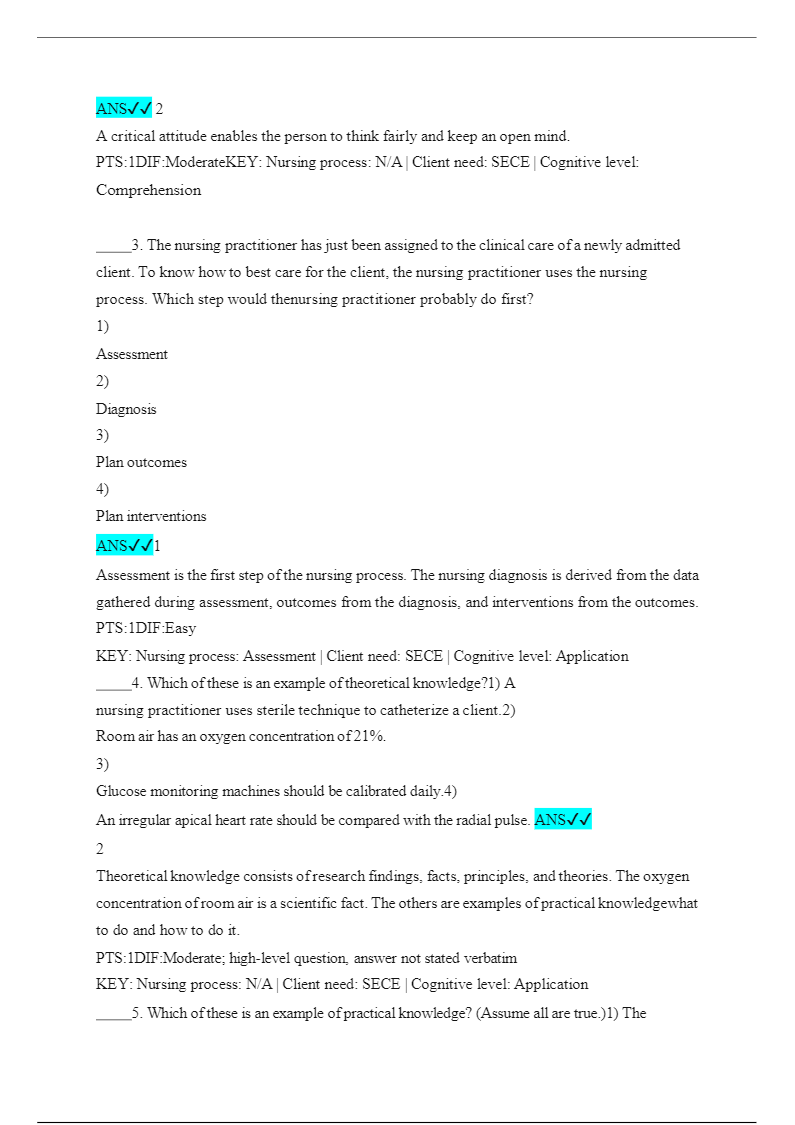
Five Sample Questions From This Test Bank
Here’s a preview of what’s included.
Question 1
A nurse is caring for four patients at the start of a shift. Which patient should the nurse assess first?
A) A patient who reports pain level 4/10, stable vital signs
B) A patient scheduled for discharge teaching this morning
C) A patient with new onset confusion, previously alert and oriented
D) A patient requesting a warm blanket
Correct Answer: C
Rationale: New onset confusion in a previously stable patient represents a significant change in condition and requires immediate assessment. This could indicate hypoxia, infection, medication reaction, or neurological changes. The other options involve stable or non-urgent needs that can wait briefly.
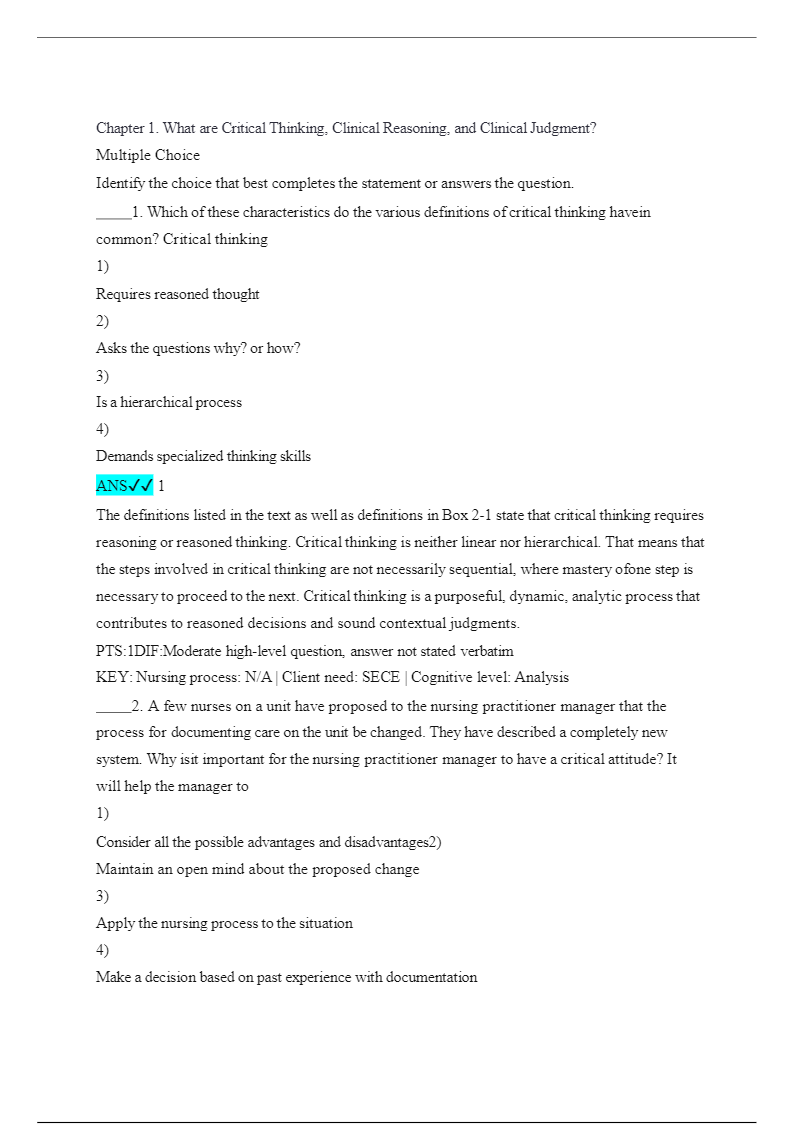
Question 2
Which behavior best demonstrates critical thinking in nursing practice?
A) Following physician orders exactly as written every time
B) Recognizing when an order doesn’t match the patient’s current condition and clarifying before proceeding
C) Completing tasks as quickly as possible to stay on schedule
D) Avoiding questions to prevent appearing incompetent
Correct Answer: B
Rationale: Critical thinking requires ongoing assessment and willingness to question situations that don’t align with clinical judgment. Blindly following orders without evaluating appropriateness ignores the nurse’s responsibility to advocate for patient safety.
Question 3
A nursing student notices that a patient’s lab values don’t match the documented diagnosis. What is the best first step?
A) Ignore the discrepancy since the physician already reviewed it
B) Investigate further by reviewing the full patient history and current presentation
C) Document the discrepancy without further action
D) Assume the lab result is an error and disregard it
Correct Answer: B
Rationale: Critical thinkers investigate inconsistencies rather than dismissing them. This reflects the “analyze cues” step of clinical judgment, where nurses gather additional data before drawing conclusions or taking action.
Question 4
Which statement reflects premature closure in clinical reasoning?
A) “I’ve considered three possible explanations for these symptoms.”
B) “This looks exactly like the last patient I had, so it must be the same thing.”
C) “I need more information before determining the cause.”
D) “Let me review the chart again before deciding.”
Correct Answer: B
Rationale: Premature closure occurs when a nurse settles on a diagnosis or explanation too quickly, often based on pattern-matching rather than thorough analysis. This increases the risk of missing the actual underlying problem.
Question 5
A nurse delegates a task to unlicensed assistive personnel. Which task is appropriate to delegate?
A) Assessing a new admission’s pain level
B) Assisting a stable patient with ambulation
C) Administering a scheduled oral medication
D) Educating a patient on new insulin administration
Correct Answer: B
Rationale: Assisting with ambulation for a stable patient falls within UAP scope of practice. Assessment, medication administration, and patient education require nursing judgment and licensure, making them inappropriate for delegation.
How To Actually Study This Material
Judgment-based content requires a different study approach than memorization-heavy courses.
Don’t rush to the answer.
Read each scenario slowly. Think through your reasoning before checking the correct response.
Explain your thinking out loud.
Even alone, verbalizing your reasoning process strengthens the thinking pattern you’re building.
Review wrong answers carefully.
Understanding why an option was incorrect teaches as much as knowing the right answer.
Practice with a study partner.
Discuss scenarios together. Different perspectives reveal thinking patterns you might miss solo.
Apply concepts to clinical rotations.
After clinical days, reflect using this framework. What did you notice? How did you interpret it? What would you do differently?
Don’t cram this content.
Thinking skills develop gradually through repeated practice, not last-minute memorization.
Who This Test Bank Is Built For
This resource supports:
- BSN and ADN nursing students
- Students preparing for Next Generation NCLEX
- Nursing programs using Alfaro-LeFevre’s textbook
- New graduate nurses strengthening clinical judgment
- Nursing instructors building exam question banks
Whether you’re taking a dedicated critical thinking course or integrating this content into a broader nursing curriculum, this test bank adapts to your needs.
Why Students Trust Test Banks Hub
We built this test bank to actually teach, not just test.
- Rationales that explain reasoning, not just correct answers
- NCLEX-aligned format matching current testing standards
- Content matched directly to the 7th edition textbook
- Instant digital access after purchase
- Affordable, straightforward pricing
Clinical judgment is consistently ranked as one of the hardest concepts for nursing students to master. This test bank exists because generic study methods don’t work for this content. You need targeted, repeated practice with real reasoning scenarios.
Frequently Asked Questions
Is this test bank aligned with the actual Alfaro-LeFevre 7th edition textbook?
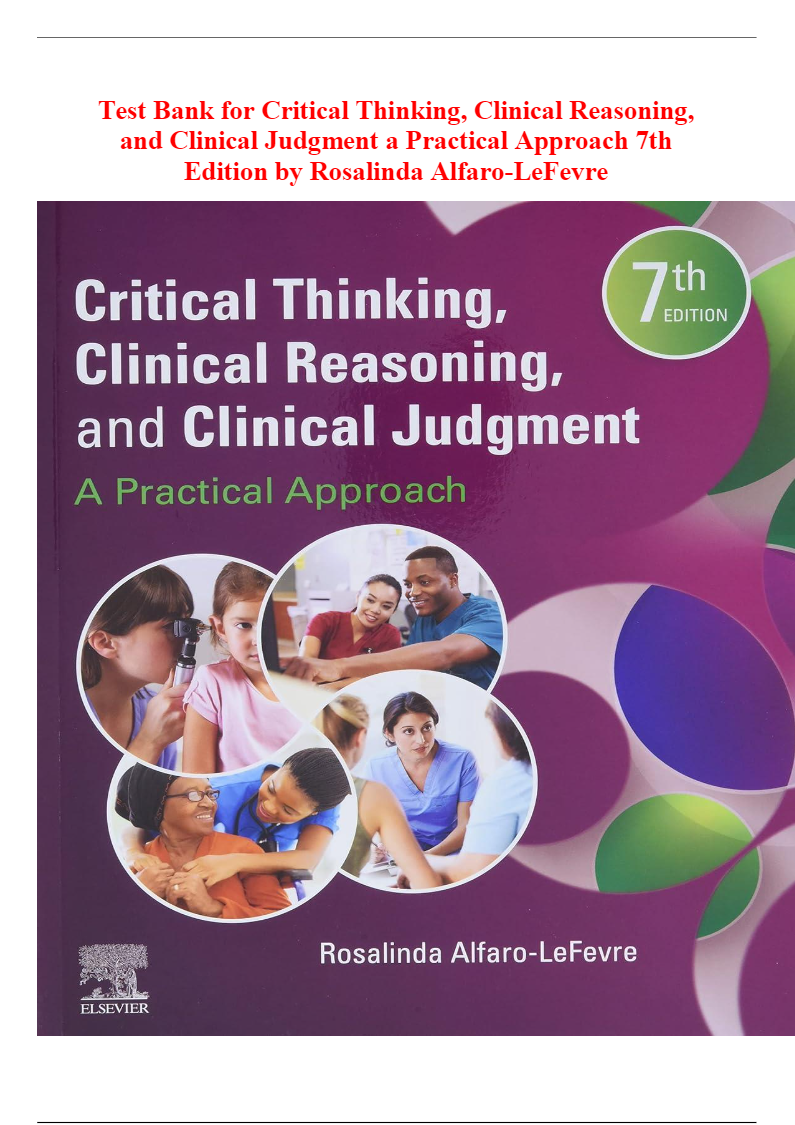
Yes. Every question corresponds to concepts, frameworks, and terminology found in Critical Thinking, Clinical Reasoning, and Clinical Judgment: A Practical Approach, 7th Edition.
Will this help me prepare for Next Generation NCLEX specifically?
Yes. This test bank incorporates the Clinical Judgment Measurement Model used in current NCLEX testing, including recognize cues, analyze cues, prioritize hypotheses, generate solutions, take action, and evaluate outcomes.
Is this course just theory, or does it apply to real clinical situations?
Both. The textbook and this test bank use realistic clinical scenarios throughout. Questions are designed to mirror actual situations you’ll encounter during clinical rotations and early practice.
I struggle with priority questions. Will this help?
Yes. A significant portion of this test bank focuses specifically on prioritization scenarios, helping you practice the reasoning process behind ranking patient needs.
How is this test bank delivered after purchase?
You receive instant digital access immediately after checkout.
Can experienced nurses use this too, or is it only for students?
While designed primarily for nursing students, new graduate nurses and those returning to school for advanced practice often use this test bank to refresh clinical judgment skills.
Does this cover ethical decision-making as well?
Yes. Questions address ethical reasoning, patient advocacy, and situations requiring nurses to balance competing obligations.
How many questions are included in this test bank?
The test bank includes hundreds of questions spanning all major textbook chapters and clinical judgment components.
Strengthen Your Clinical Thinking Today
Clinical judgment isn’t something you’re born with. It’s a skill built through deliberate, repeated practice.
This test bank gives you that practice. Real scenarios. Real reasoning. Real rationales explaining the thinking behind every answer.
Get instant access today and start building the judgment skills that define excellent nursing practice.


Peterson S. –
Very very good
Norah Helen –
Much better than expected
Caleb Martins –
clear and concise rationales
Lisa Horton –
Perfect
Dorcas M. –
Very helpful in preparing for exams