Every time you press that exposure button, radiation passes through a patient’s body. Some of it scatters back toward you. Some accumulates in tissue you’ll never see damage to until years later.
Radiation protection isn’t a box to check before clinical rotations. It’s the knowledge that keeps you, your patients, and your future coworkers safe across an entire career of daily radiation exposure.
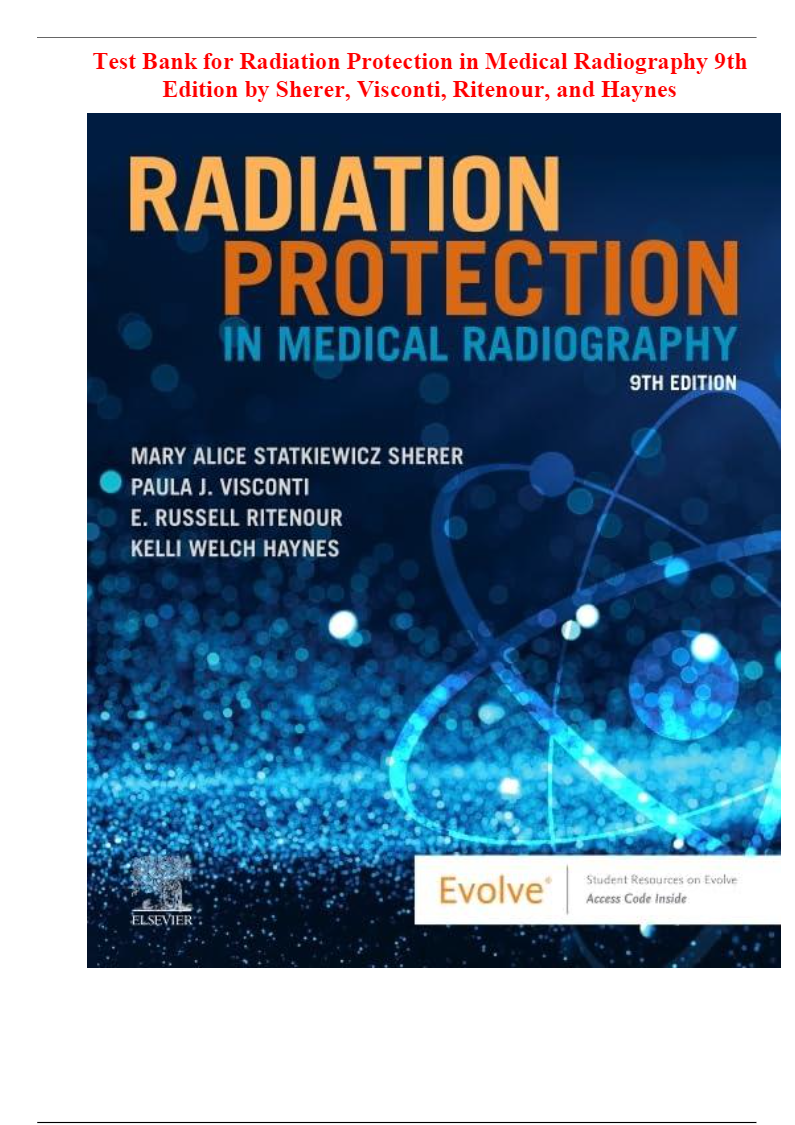
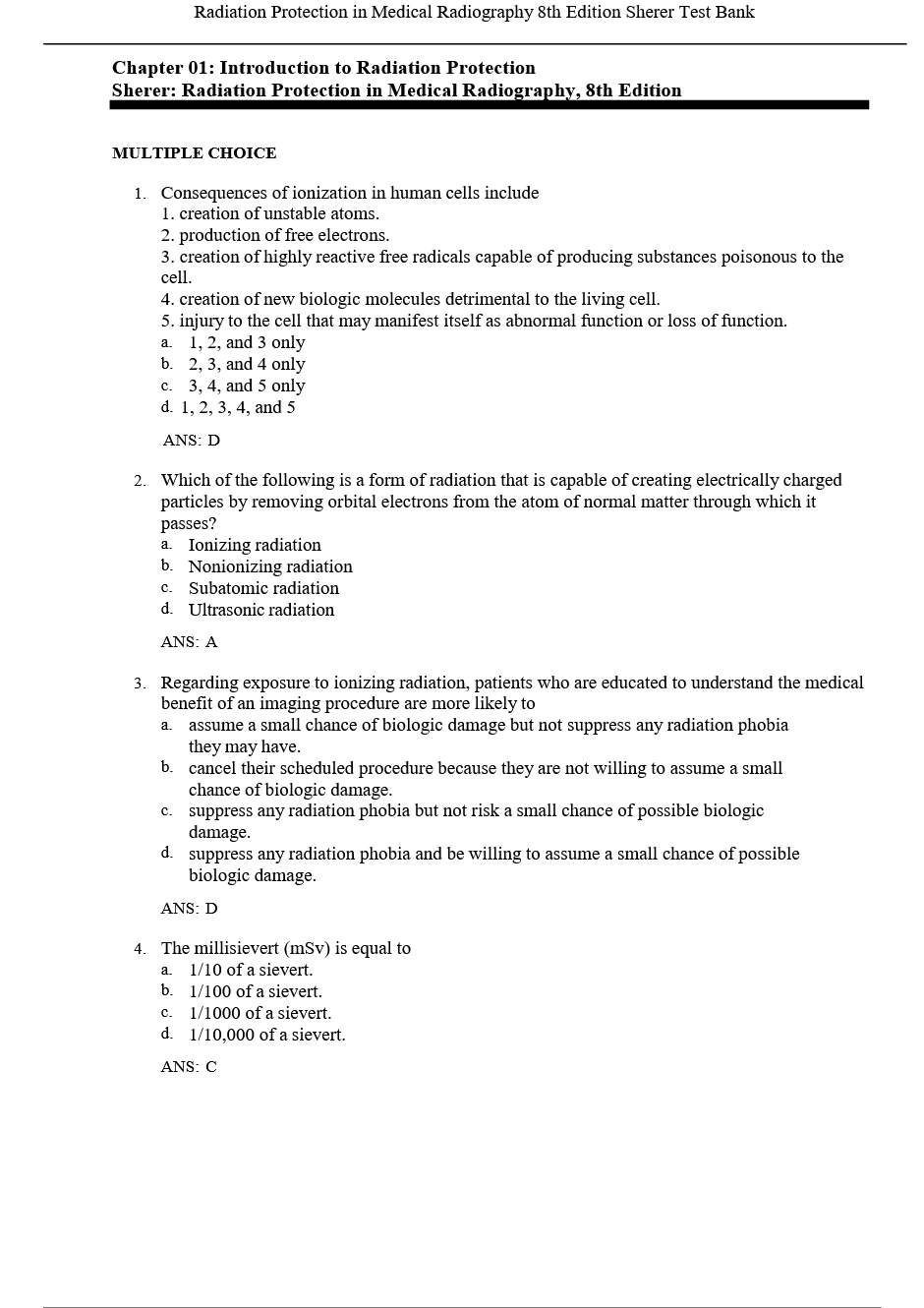
Sherer’s textbook has trained radiologic technologists on radiation safety principles for decades. This test bank, built directly from the 9th edition, gives you focused practice on dose calculations, protection principles, and regulatory standards that show up constantly on ARRT exams.
At Test Banks Hub, we built this resource because radiation protection content requires precision. There’s no partial credit for “close enough” when it comes to dose limits.
Why Radiation Protection Content Demands Precision
This isn’t a subject where general understanding gets you by.
Here’s what makes it uniquely demanding:
- Dose limits are specific numbers you must memorize exactly
- Units of measurement (rad, rem, Gray, Sievert) confuse students constantly
- Calculations require precise mathematical application, not estimation
- Regulatory standards change and vary between organizations
- ALARA principles sound simple but apply differently across situations
This test bank builds the exact recall and calculation skills your certification exam demands. Repetition here isn’t optional. It’s how this content actually sticks.
What This Test Bank Covers
Every major content area from the textbook receives thorough question coverage.
Radiation Physics Fundamentals
- X-ray production and characteristics
- Interaction of radiation with matter
- Photoelectric effect and Compton scattering
- Factors affecting radiation quality and quantity
Biological Effects of Radiation
- Cellular response to radiation exposure
- Deterministic versus stochastic effects
- Acute radiation syndrome
- Long-term effects including cancer risk and genetic effects
Radiation Units and Measurement
- Traditional units (rad, rem, roentgen)
- SI units (Gray, Sievert)
- Converting between unit systems
- Dose calculation methods
Radiation Protection Principles
- Time, distance, and shielding concepts
- ALARA principle application
- Inverse square law calculations
- Personnel monitoring devices
Equipment and Facility Design
- Collimation and beam restriction
- Filtration requirements
- Shielding materials and thickness calculations
- Room design and structural shielding
Regulatory Standards and Dose Limits
- Occupational dose limits
- Public dose limits
- Pregnancy-related radiation policies
- Regulatory agencies and their roles
Patient Protection Techniques
- Gonadal shielding
- Technique selection to minimize dose
- Pediatric dose reduction strategies
- Repeat exposure prevention
Every question includes a full rationale explaining the physics and regulatory reasoning behind correct answers. You’ll understand why specific dose limits exist, not just memorize numbers blindly.
Question Formats You’ll Practice
- Multiple choice questions testing conceptual understanding
- Calculation-based problems requiring exact numerical answers
- Matching exercises for units and terminology
- Scenario-based questions applying protection principles to clinical situations
This mix mirrors the ARRT exam format, which combines conceptual and calculation-based questions extensively.
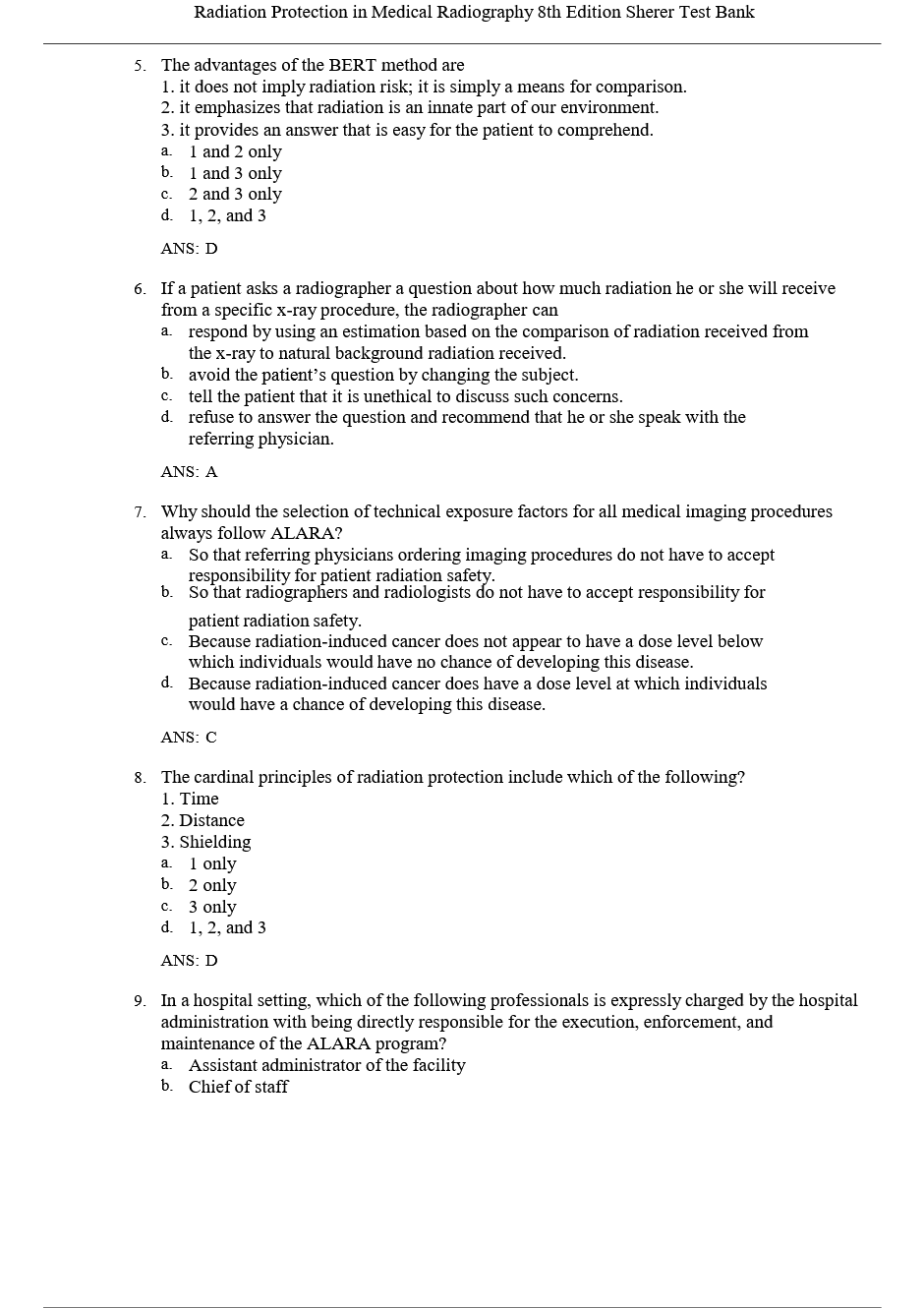
Five Sample Questions From This Test Bank
Here’s a preview of what’s included.
Question 1
According to the inverse square law, if the distance from a radiation source is doubled, the intensity of radiation exposure will:
A) Double
B) Remain the same
C) Decrease to one-fourth of the original intensity
D) Decrease by half
Correct Answer: C
Rationale: The inverse square law states that radiation intensity is inversely proportional to the square of the distance from the source. Doubling the distance decreases intensity to one-fourth (1/2² = 1/4) of the original value, making distance one of the most effective radiation protection strategies.
Question 2
What is the current annual occupational effective dose limit for radiation workers according to NCRP recommendations?
A) 5 rem (50 mSv)
B) 0.5 rem (5 mSv)
C) 50 rem (500 mSv)
D) 1 rem (10 mSv)
Correct Answer: A
Rationale: The NCRP recommends an annual occupational effective dose limit of 5 rem (50 mSv) for radiation workers. This limit is designed to keep stochastic effect risk at an acceptable level over a career of occupational exposure.
Question 3
Which type of personnel monitoring device provides immediate dose readings during a procedure?
A) Film badge
B) Thermoluminescent dosimeter (TLD)
C) Optically stimulated luminescence (OSL) dosimeter
D) Pocket ionization chamber
Correct Answer: D
Rationale: Pocket ionization chambers provide immediate, real-time dose readings, unlike film badges, TLDs, and OSL dosimeters, which require processing after the exposure period to determine cumulative dose.
Question 4
A lead apron with 0.5mm lead equivalent thickness is required for personnel present during fluoroscopic procedures. What is the primary purpose of this thickness specification?
A) To eliminate all scatter radiation exposure
B) To attenuate scatter radiation to an acceptable level while remaining practical to wear
C) To block the primary radiation beam completely
D) To meet aesthetic requirements only
Correct Answer: B
Rationale: Lead aprons are designed to attenuate scatter radiation, which has lower energy than the primary beam, to acceptable levels. Complete radiation elimination isn’t the goal, since aprons must remain lightweight enough for practical daily use.
Question 5
Which factor has the greatest impact on reducing patient dose during a radiographic exam without compromising image quality?
A) Increasing source-to-image distance excessively
B) Proper collimation to the area of clinical interest
C) Removing all filtration from the x-ray beam
D) Increasing repeat exposure rates
Correct Answer: B
Rationale: Proper collimation restricts the beam to only the anatomy of clinical interest, directly reducing patient dose and scatter radiation without sacrificing diagnostic image quality. This remains one of the most practical, everyday dose reduction techniques technologists control directly.
How To Study This Material Effectively
Radiation protection content rewards precise, calculation-focused practice.
Memorize dose limits exactly, not approximately.
This content requires precision. “About 5 rem” isn’t good enough when exam questions test exact figures.
Practice unit conversions repeatedly.
Converting between rad/rem and Gray/Sievert trips up many students. Repeated practice builds fluency here.
Work through inverse square law calculations by hand.
Don’t just memorize the formula. Practice applying it to different distance scenarios until the math becomes automatic.
Create comparison charts for monitoring devices.
Film badges, TLDs, OSL dosimeters, and pocket chambers each have distinct characteristics. Side-by-side comparison clarifies differences quickly.
Connect protection principles to real clinical scenarios.
Understanding why collimation reduces dose, not just that it does, builds retention that lasts beyond the exam.
Who This Test Bank Is Built For
This resource supports:
- Radiologic technology students
- Students preparing for ARRT certification
- Radiography program instructors building exam content
- Practicing technologists needing continuing education review
Whether you’re working through a dedicated radiation protection course or doing focused registry exam review, this test bank fits your preparation needs.
Why Students Choose Test Banks Hub
We build test banks that match the precision this content demands.
- Detailed rationales explaining physics and regulatory reasoning
- Calculation practice matching real exam question formats
- ARRT-aligned content reflecting current certification standards
- Instant digital access after purchase
- Affordable pricing for student budgets
Radiation safety protects patients, coworkers, and your own long-term health. This test bank builds the precise knowledge that responsibility requires.
Frequently Asked Questions
Is this test bank based on the actual Sherer 9th edition textbook?
Yes. Every question aligns with chapters, dose limits, and protection principles found in Radiation Protection in Medical Radiography, 9th Edition.
Will this help me prepare for the ARRT certification exam specifically?
Yes. Radiation protection is a significant content category on the ARRT exam, and this test bank’s format and content coverage align directly with registry exam expectations.
Does this test bank include calculation-based questions, or just conceptual ones?
Both. You’ll find extensive calculation practice involving inverse square law, dose conversions, and shielding requirements, alongside conceptual questions on protection principles.
How is this test bank delivered after purchase?
You receive instant digital access immediately after checkout.
I always mix up rad, rem, Gray, and Sievert. Will this help?
Yes. Multiple questions specifically address unit conversions and distinctions between traditional and SI units, helping build clarity around this commonly confused topic.
Does this cover current dose limits, or outdated standards?
The 9th edition reflects current NCRP and regulatory dose limit recommendations. Always verify against current regulatory updates, as standards can be revised between textbook editions.
Is this useful for practicing technologists, or only students?
Both. While designed primarily for students, practicing technologists often use this test bank for continuing education review and certification renewal preparation.
How many questions are included in this test bank?
The test bank includes several hundred questions spanning all major radiation protection topics and calculation types covered in the textbook.
Start Building Radiation Safety Competence Today
Radiation protection knowledge isn’t optional in this field. It’s the foundation that keeps you practicing safely for decades, and keeps your patients safe with every single exposure you perform.
This test bank gives you that foundation. Real calculations. Detailed rationales explaining the physics and regulations behind every answer. Complete alignment with your textbook.
Get instant access today and start building the precise radiation safety knowledge your career depends on.

Reviews
There are no reviews yet.