Foundations courses cover the building blocks everything else in nursing school rests on. Vital signs, basic assessment, infection control, medication administration, and the core nursing skills you’ll use every single shift. It doesn’t always feel exciting compared to more specialized courses, but it’s the material that quietly shows up on every exam that comes after it.
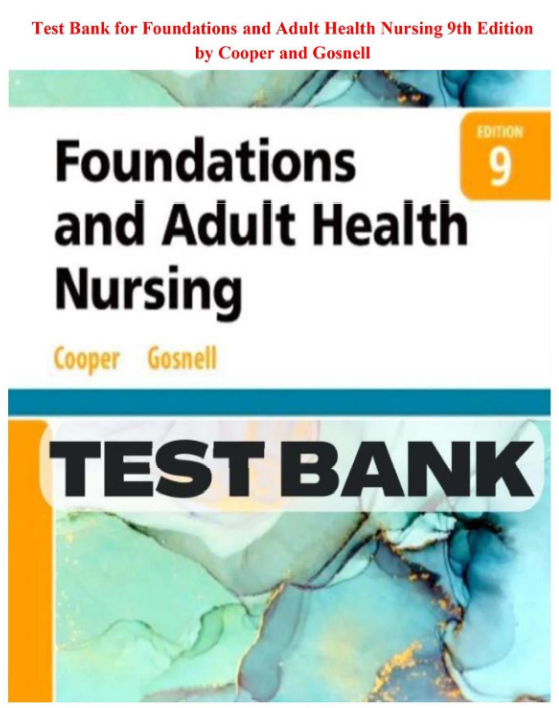
This test bank is built to help that foundation actually hold. It follows the 9th edition of Foundations and Adult Health Nursing by Kim Cooper and Kelly Gosnell, chapter by chapter. Whatever unit you’re covering in class, there’s a matching set of practice questions ready for you.
This resource isn’t a shortcut around learning basic nursing skills. It’s a way to check whether that early material has really stuck. Reading about proper hand hygiene technique is one thing. Applying infection control principles correctly in a scenario question is a different skill, and that’s exactly what repeated practice builds.
What Is a Test Bank?
A test bank is a large collection of practice questions tied to a specific textbook. Instructors often draw from resources like this when writing their own exams. That means studying with this test bank trains you on the same style, format, and difficulty level your real exam is likely to use.
This resource spans the full scope of the 9th edition, including basic nursing skills, infection control, vital signs, pain management, nutrition, mobility, wound care, and adult health conditions across body systems like cardiovascular, respiratory, and gastrointestinal care.
Why Nursing Students Use Test Banks for Foundations Courses
Foundations content might seem simple on the surface, but exams often test small details that are easy to overlook. A test bank helps catch those details through repeated practice. Here’s how.
You reinforce core skills before they’re tested again later. Concepts like proper body mechanics or sterile technique show up again and again in more advanced courses. Practicing with exam-style questions now builds a foundation that pays off later.
You find your weak spots before the exam does. Maybe vital sign ranges feel solid, but wound care stages still feel fuzzy. Practice questions point you straight to what needs more review.
You build confidence for exam day. The more familiar the question format feels, the calmer you’ll be when the real test starts. That matters even in foundational courses, where nerves can still cause careless mistakes.
You study more efficiently. Instead of rereading entire chapters hoping the right details stick, the material is already organized and ready for focused review.
What’s Inside This Test Bank
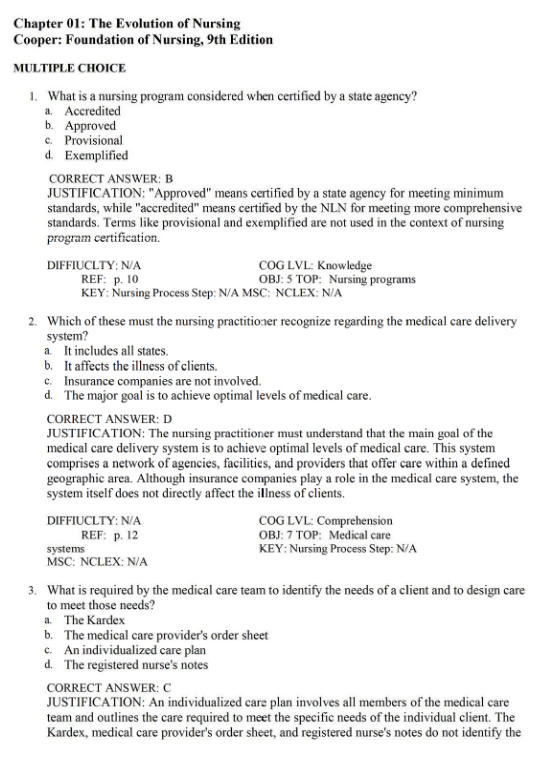
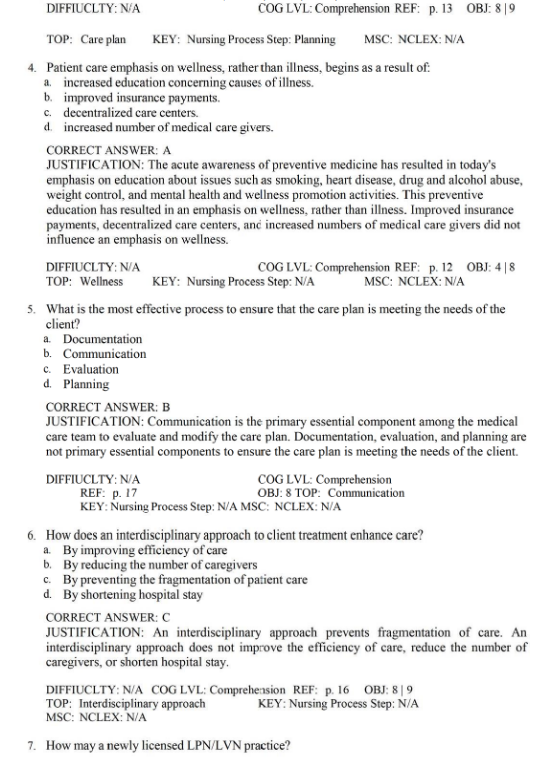
This resource includes multiple-choice questions organized by chapter, each with a correct answer and a rationale explaining why. The rationale is where the real learning happens. Foundational nursing questions often test procedure and sequence, not just facts. Understanding why one action comes before another is what actually prepares you for real clinical practice, not just for passing a test.
Topics covered include:
- Basic nursing skills and the nursing process
- Infection control and standard precautions
- Vital signs and physical assessment
- Pain assessment and management
- Nutrition and fluid balance
- Mobility, positioning, and body mechanics
- Wound care and pressure injury prevention
- Medication administration principles
- Cardiovascular and respiratory adult health conditions
- Gastrointestinal and musculoskeletal adult health conditions
Sample Questions
Here are five sample questions similar to what’s inside the full test bank. Try answering them before checking the rationale.
Question 1
A nurse is preparing to insert an indwelling urinary catheter. Which action is essential to maintain sterile technique?
A. Wearing clean, non-sterile gloves throughout the procedure
B. Opening the sterile kit and keeping the inner wrapper as a sterile field
C. Touching only the outer edges of the sterile field with bare hands
D. Placing the sterile kit directly on the patient’s bed linens
Correct Answer: B. Opening the sterile kit and keeping the inner wrapper as a sterile field
Rationale: The inner wrapper of a sterile kit is designed to serve as a sterile field once opened correctly, keeping supplies uncontaminated during the procedure. Clean, non-sterile gloves would contaminate a procedure requiring strict sterile technique. Touching even the outer edges of a sterile field with bare hands risks contamination. Placing a sterile kit directly on unclean bed linens without a proper barrier also risks contamination.
Question 2
A nurse is assessing a client’s pulse and notes a rate of 52 beats per minute with a regular rhythm. Which term correctly describes this finding?
A. Tachycardia
B. Bradycardia
C. Dysrhythmia
D. Normal sinus rhythm
Correct Answer: B. Bradycardia
Rationale: A heart rate below 60 beats per minute in an adult is defined as bradycardia. Tachycardia refers to a rate above 100 beats per minute, which doesn’t match this finding. Dysrhythmia refers to an irregular rhythm, but this pulse is described as regular. Normal sinus rhythm typically falls between 60 and 100 beats per minute, so this rate falls below that range.
Question 3
A nurse is repositioning a client who is at risk for pressure injuries. Which action best reflects proper body mechanics for the nurse?
A. Bending at the waist and lifting with the back
B. Keeping the client close to the body and bending at the knees
C. Twisting the torso while lifting to reach the client faster
D. Lifting alone whenever possible to save time
Correct Answer: B. Keeping the client close to the body and bending at the knees
Rationale: Proper body mechanics involve keeping the object or client close to the body and using the legs, not the back, to lift, which reduces strain and injury risk. Bending at the waist and lifting with the back increases the risk of back injury. Twisting while lifting significantly raises injury risk. Lifting alone when help is needed, especially for a client at risk for injury, is unsafe practice.
Question 4
A nurse is assessing a client’s pressure injury and notes full-thickness tissue loss with visible fat, but no exposed bone, tendon, or muscle. Which stage does this finding represent?
A. Stage 1
B. Stage 2
C. Stage 3
D. Stage 4
Correct Answer: C. Stage 3
Rationale: Stage 3 pressure injuries involve full-thickness tissue loss with visible fat, but without exposed bone, tendon, or muscle. Stage 1 involves intact skin with non-blanchable redness. Stage 2 involves partial-thickness skin loss, often presenting as a shallow open wound or blister. Stage 4 involves full-thickness tissue loss with exposed bone, tendon, or muscle, which is not present in this description.
Question 5
A nurse is caring for a client on a clear liquid diet following abdominal surgery. Which item is appropriate for the nurse to offer?
A. Orange juice with pulp
B. Chicken broth
C. Vanilla pudding
D. Mashed potatoes
Correct Answer: B. Chicken broth
Rationale: Chicken broth is a clear liquid that can be seen through and leaves no residue, fitting the criteria for a clear liquid diet. Orange juice with pulp contains solid particles, making it unsuitable. Vanilla pudding and mashed potatoes are both considered full liquid or solid foods, not clear liquids, and wouldn’t be appropriate at this stage of dietary progression.
Who This Test Bank Is For
This resource fits nursing students currently taking a foundations or fundamentals of nursing course, often combined with introductory adult health content. It also supports NCLEX preparation, since foundational nursing skills and safety principles are heavily tested throughout the exam. Instructors may find it useful too, as a reference for building quizzes or exam material.
How to Study With This Test Bank
Don’t just read through the questions passively. Quiz yourself for real. Cover the answer choices, pick one, then check the rationale closely. Foundations questions often test procedure and sequence, so paying attention to why one action comes before another is exactly the skill your real exam will test.
Working through one skill or chapter at a time tends to work better than trying to cover everything in one sitting. Spacing your review out over several days helps these foundational details actually stick, since they’ll come up again in almost every course after this one.
Instant Digital Access
This test bank is delivered as a digital file, so there’s no shipping wait. Once your order is complete, you can download it and start studying right away. It’s designed to work alongside your textbook and class notes, not replace either one.
Frequently Asked Questions
Is this the same as the textbook itself?
No. This is a test bank, meaning a collection of practice questions. It’s meant to be used together with the textbook, not instead of it.
Does every question include a rationale?
Yes. Each question comes with the correct answer along with a clear explanation of why that answer is right.
Will this help me prepare for the NCLEX?
It can. Foundational nursing skills and safety principles are heavily represented throughout the NCLEX, so this practice builds directly relevant skills.
Is this test bank matched to the 9th edition specifically?
Yes. The questions are organized to align with the chapters and content found in the 9th edition of Foundations and Adult Health Nursing by Cooper and Gosnell.
How do I receive the file after purchasing?
You’ll get instant digital access right after checkout, so you can start studying immediately.
Can instructors use this resource too?
Yes. Instructors often use test banks as a reference when building quizzes, exams, or review sessions.
Is using a test bank considered cheating?
No, as long as it’s used for studying and practice rather than during an actual exam. Reviewing practice questions to strengthen understanding is a common and accepted study method among nursing students.


Martini508 –
Great explanations included
whitney –
Perfect for quick revision