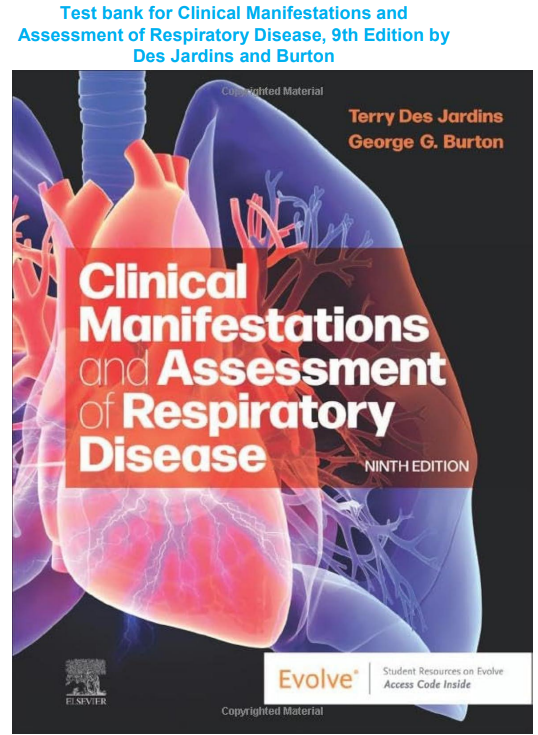
Respiratory disease courses ask a lot of you. You’re expected to connect a disease process to its underlying pathophysiology, then link that to the actual clinical signs a patient shows up with, and finally figure out what those signs mean for treatment. That’s three layers of thinking stacked on top of each other, and it’s easy to lose your footing somewhere in the middle.
This test bank is built to help steady that. It follows the 9th edition of Clinical Manifestations and Assessment of Respiratory Disease by Terry Des Jardins and George Burton, chapter by chapter. Whatever respiratory condition you’re covering in class, there’s a matching set of practice questions ready for you.
This resource won’t replace working through the textbook’s case studies and clinical scenarios. What it does is give you a fast way to check whether the material actually clicked. Recognizing a concept while reading is one thing. Pulling it up correctly under exam pressure is a different skill, and that’s exactly what repeated practice builds.
What Is a Test Bank?
A test bank is a large collection of practice questions built around a specific textbook. Instructors often draw from resources like this when writing their actual course exams. That means studying with this test bank familiarizes you with the tone, structure, and difficulty level your real exam is likely to use.
This resource spans the full scope of the 9th edition, including obstructive and restrictive lung diseases, pulmonary vascular disease, infectious respiratory conditions, and the clinical manifestations and assessment findings tied to each one, such as breath sounds, chest x-ray patterns, and arterial blood gas changes.
Why Students Use Test Banks for This Course
Respiratory disease content asks you to connect the dots between cause, presentation, and assessment findings, not just memorize isolated facts. A test bank helps train that connection through repeated practice. Here’s how.
You get better at linking symptoms to underlying disease processes. Exam questions in this course often present a set of clinical findings and ask you to identify the condition. Practicing with similar questions trains you to recognize these patterns quickly.
You find your weak spots before the exam does. Maybe COPD feels straightforward, but pulmonary embolism findings still feel fuzzy. Practice questions point you straight to what needs more review.
You build confidence heading into the exam. The more familiar the question format feels, the calmer you’ll be when the real test starts. That matters in a subject with a lot of overlapping symptoms across different conditions.
You study more efficiently. Instead of flipping through dense chapters trying to guess what’s testable, the material is already organized and ready to review.
What’s Inside This Test Bank
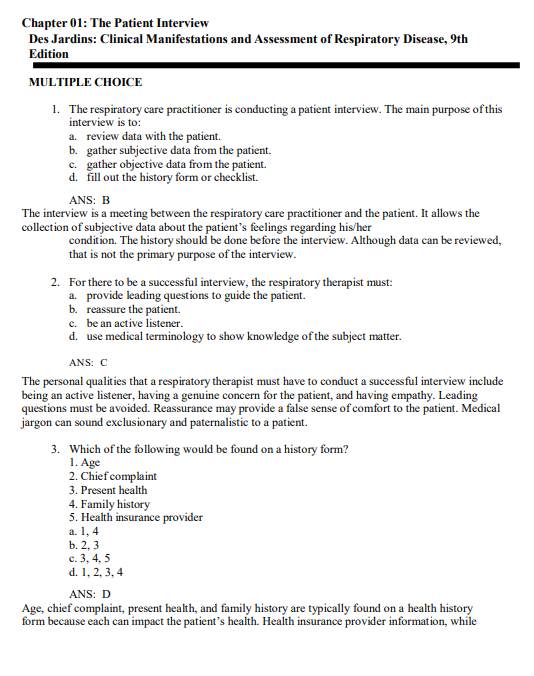
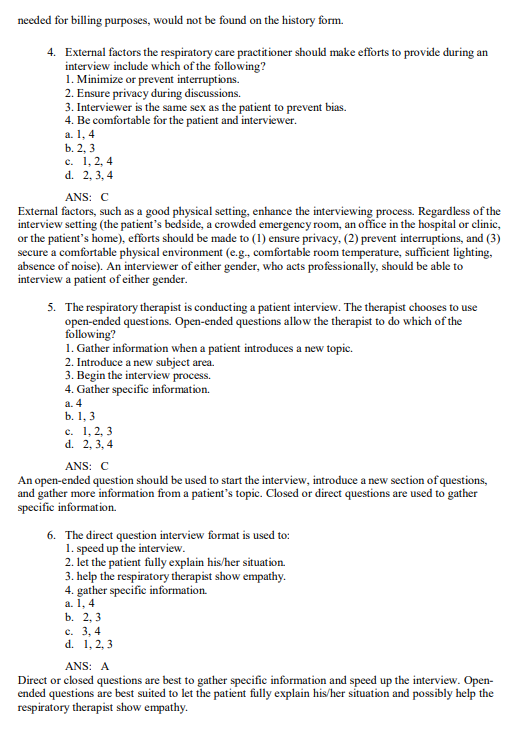
This resource includes multiple-choice questions organized by chapter, each with a correct answer and a rationale explaining why that answer is correct. The rationale is where the real learning happens. Many respiratory conditions share overlapping symptoms, like shortness of breath or crackles on auscultation. Understanding why one diagnosis fits better than another based on the full clinical picture is what actually prepares you for real assessment work, not just for passing a test.
Topics covered include:
- Chronic obstructive pulmonary disease (COPD) and chronic bronchitis
- Asthma and reactive airway conditions
- Pneumonia and other infectious respiratory diseases
- Tuberculosis
- Pulmonary embolism and pulmonary vascular disease
- Restrictive lung diseases and pulmonary fibrosis
- Pleural effusion and pneumothorax
- Acute respiratory distress syndrome (ARDS)
- Interpreting arterial blood gases and pulmonary function tests
- Chest assessment findings, including breath sounds and imaging patterns
Sample Questions
Here are five sample questions similar to what’s inside the full test bank. Try answering them before checking the rationale.
Question 1
A patient with a long smoking history presents with a chronic productive cough for the past three months, occurring in two consecutive years. Which condition is most consistent with this presentation?
A. Asthma
B. Chronic bronchitis
C. Pulmonary fibrosis
D. Pneumothorax
Correct Answer: B. Chronic bronchitis
Rationale: Chronic bronchitis is clinically defined by a productive cough present for at least three months in two consecutive years, often linked to a significant smoking history. Asthma typically involves episodic wheezing and reversible airflow obstruction rather than a chronic productive cough of this duration. Pulmonary fibrosis usually presents with a dry cough and progressive shortness of breath. Pneumothorax presents acutely with sudden chest pain and shortness of breath, not a chronic cough pattern.
Question 2
A patient with pneumonia has decreased breath sounds, dull percussion, and increased tactile fremitus over the affected lung area. Which process best explains these findings?
A. Air trapping
B. Consolidation
C. Pleural effusion
D. Pneumothorax
Correct Answer: B. Consolidation
Rationale: Consolidation occurs when alveoli fill with fluid or exudate, as in pneumonia, which increases tactile fremitus and produces dull percussion due to reduced air content. Air trapping typically produces hyperresonance, not dullness. Pleural effusion usually causes decreased or absent tactile fremitus, not increased, since fluid dampens vibration. Pneumothorax also causes decreased fremitus along with hyperresonant percussion, not dullness.
Question 3
A patient presents with sudden onset shortness of breath, pleuritic chest pain, and tachycardia after a long period of immobility following surgery. Which condition should be suspected first?
A. Pneumonia
B. Pulmonary embolism
C. Asthma exacerbation
D. Chronic bronchitis
Correct Answer: B. Pulmonary embolism
Rationale: Sudden onset of shortness of breath, pleuritic chest pain, and tachycardia following a period of immobility strongly suggests pulmonary embolism due to increased clot risk. Pneumonia typically develops more gradually and often includes fever and productive cough. Asthma exacerbations usually involve wheezing and a known trigger rather than a sudden event tied to immobility. Chronic bronchitis presents with a long-term productive cough, not a sudden acute event like this one.
Question 4
Arterial blood gas results show a low PaO2, elevated PaCO2, and low pH. Which acid-base imbalance is reflected in these findings?
A. Respiratory alkalosis
B. Metabolic alkalosis
C. Respiratory acidosis
D. Metabolic acidosis
Correct Answer: C. Respiratory acidosis
Rationale: An elevated PaCO2 paired with a low pH indicates respiratory acidosis, typically caused by inadequate ventilation and carbon dioxide retention. Respiratory alkalosis would show a low PaCO2 with a high pH, from hyperventilation. Metabolic alkalosis and metabolic acidosis both reflect bicarbonate imbalances rather than a primary problem with carbon dioxide elimination, and wouldn’t present with this direct PaCO2 pattern.
Question 5
A patient involved in a motor vehicle accident develops sudden chest pain, absent breath sounds on one side, and tracheal deviation away from the affected side. Which condition is most consistent with these findings?
A. Pleural effusion
B. Tension pneumothorax
C. Pneumonia
D. Atelectasis
Correct Answer: B. Tension pneumothorax
Rationale: Tracheal deviation away from the affected side, along with absent breath sounds and sudden chest pain following trauma, is a classic and urgent sign of tension pneumothorax, caused by pressure building in the pleural space. Pleural effusion typically causes decreased, not absent, breath sounds and does not usually cause significant tracheal deviation. Pneumonia develops more gradually and does not cause tracheal shift. Atelectasis can cause tracheal deviation toward the affected side, not away from it, due to lung collapse rather than pressure buildup.
Who This Test Bank Is For
This resource fits students in respiratory therapy programs, nursing programs, and other allied health courses that cover respiratory disease in depth. It’s especially useful for students preparing for board or certification exams that test clinical assessment skills tied to respiratory conditions. Instructors may also find it useful as a reference for building quizzes or exam material.
How to Study With This Test Bank
Don’t just skim through the questions passively. Quiz yourself for real. Cover the answer choices, commit to a pick, then read the rationale carefully. Many respiratory conditions share overlapping symptoms, so slowing down to understand the distinguishing details is exactly the skill your real exam will test.
Working through one condition or chapter at a time tends to work better than trying to cover everything in one sitting. Spacing your review out over several days helps these overlapping symptom patterns stay distinct in your memory instead of blurring together.
Instant Digital Access
This test bank is delivered as a digital file, so there’s no shipping wait. Once your order is complete, you can download it and start studying right away. It’s designed to work alongside your textbook and class notes, not replace either one.
Frequently Asked Questions
Is this the same as the textbook itself?
No. This is a test bank, meaning a collection of practice questions. It’s meant to be used together with the textbook, not instead of it.
Does every question include a rationale?
Yes. Each question comes with the correct answer along with a clear explanation of why that answer fits best.
Will this help me prepare for board or certification exams?
It can. Clinical assessment of respiratory disease is a core topic on many respiratory therapy and nursing certification exams, so this practice builds directly relevant skills.
Is this test bank matched to the 9th edition specifically?
Yes. The questions are organized to align with the chapters and content found in the 9th edition of Clinical Manifestations and Assessment of Respiratory Disease by Des Jardins and Burton.
How do I receive the file after purchasing?
You’ll get instant digital access right after checkout, so you can start studying immediately.
Can instructors use this resource too?
Yes. Instructors often use test banks as a reference when building quizzes, exams, or review sessions.
Is using a test bank considered cheating?
No, as long as it’s used for studying and practice rather than during an actual exam. Reviewing practice questions to strengthen understanding is a common and accepted study method among students.


Jackiemarine –
Exactly what I needed for my homework and exam preps
westonemax –
comprehensive, detailed, and accurate.
Lucille Maria –
Excellent