Maternity nursing covers a lot of territory. You’re tracking a pregnancy from conception through delivery, learning how to recognize when something’s going wrong, and also studying women’s health topics that stretch well beyond pregnancy itself. It’s a wide subject, and it’s easy to feel like you’re memorizing faster than you’re actually understanding.
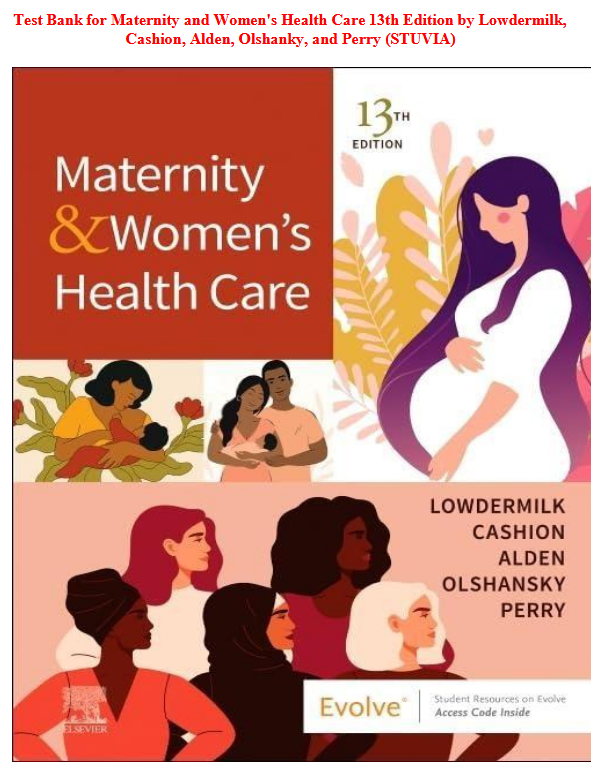
This test bank is built to help close that gap. It follows the 13th edition of Maternity and Women’s Health Care by Deitra Leonard Lowdermilk, Shannon E. Perry, and colleagues, chapter by chapter. Whatever unit you’re working through in class, there’s a matching set of practice questions ready for you.
This resource isn’t a way to skip studying. It’s a way to test whether the material actually stuck. Reading about fetal monitoring patterns is one thing. Correctly identifying one under exam pressure is a different skill entirely, and that’s exactly what repeated practice builds.
What Is a Test Bank?
A test bank is a large collection of practice questions tied to a specific textbook. Instructors often draw from resources like this when building their real exams. That means studying with this test bank trains you on the same style, format, and difficulty level your real exam is likely to use.
This resource spans the full scope of the 13th edition, including preconception and prenatal care, labor and birth, postpartum recovery, newborn care, high-risk pregnancy conditions, and broader women’s health topics like reproductive health, menopause, and gynecologic conditions.
Why Nursing Students Use Test Banks for Maternity Courses
Maternity content mixes normal physiology with the ability to spot when something’s abnormal, fast. A test bank helps train that recognition through repeated, targeted practice. Here’s how.
You get sharper at recognizing warning signs. Maternity exams often describe a set of findings and ask whether they’re normal or require action. Practicing with similar questions trains you to catch subtle red flags quickly.
You find your weak spots before the exam does. Maybe labor stages feel solid, but high-risk pregnancy complications still feel shaky. Practice questions point you straight to what needs more review.
You build confidence for exam day. The more familiar the question format feels, the calmer you’ll be when the real test starts. A calm mind catches details a rattled one misses.
You study more efficiently. Instead of flipping through dense chapters trying to guess what’s testable, the material is already organized and ready for review.
What’s Inside This Test Bank
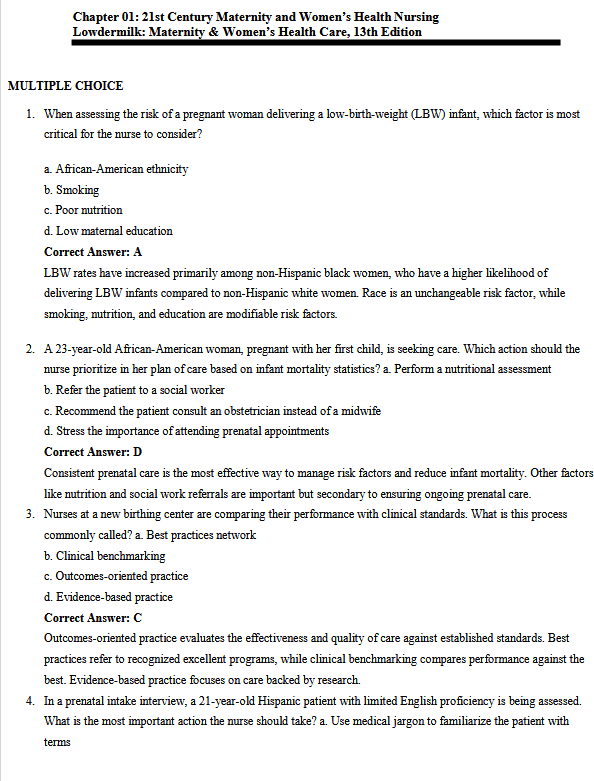
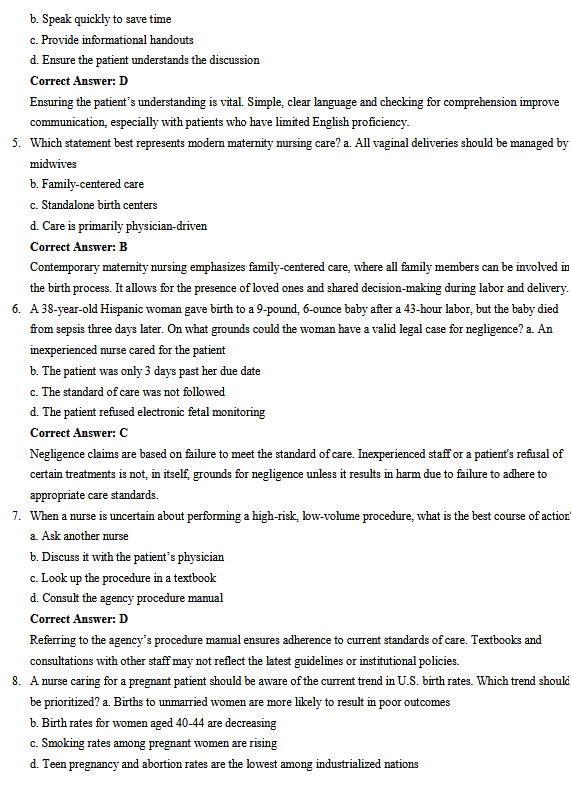
This resource includes multiple-choice questions organized by chapter, each with a correct answer and a rationale explaining why. The rationale matters just as much as the answer. Memorizing “the answer is C” doesn’t help much if the exam phrases the question differently. Understanding why C is correct is what actually transfers to unfamiliar questions later.
Topics covered include:
- Preconception counseling and reproductive anatomy
- Prenatal care and fetal development
- High-risk pregnancy conditions
- Labor and birth, including fetal monitoring
- Pain management during labor
- Postpartum physical and emotional recovery
- Newborn assessment and care
- Breastfeeding and infant nutrition
- Women’s health across the lifespan, including menopause and gynecologic conditions
- Family planning and contraception
Sample Questions
Here are five sample questions similar to what’s inside the full test bank. Try answering them before checking the rationale.
Question 1
A client at 10 weeks gestation reports spotting and mild cramping. On examination, the cervix is closed. Which term best describes this presentation?
A. Inevitable abortion
B. Threatened abortion
C. Incomplete abortion
D. Missed abortion
Correct Answer: B. Threatened abortion
Rationale: A threatened abortion involves bleeding and cramping in early pregnancy with a closed cervix, meaning the pregnancy may still continue. An inevitable abortion involves an open cervix with bleeding, indicating pregnancy loss cannot be prevented. An incomplete abortion involves passage of some but not all products of conception. A missed abortion involves fetal death without expulsion of tissue, often without notable bleeding at first.
Question 2
A nurse reviewing a fetal heart rate tracing notes a baseline of 150 beats per minute with moderate variability and no decelerations. How should the nurse interpret this tracing?
A. Category I, reassuring
B. Category II, indeterminate
C. Category III, abnormal
D. Non-interpretable tracing
Correct Answer: A. Category I, reassuring
Rationale: A Category I tracing includes a normal baseline, moderate variability, and no concerning decelerations, indicating the fetus is well oxygenated at this time. Category II tracings include findings that don’t clearly fit reassuring or abnormal criteria. Category III tracings show absent variability with recurrent late or variable decelerations, or a sinusoidal pattern, none of which apply here. This tracing has sufficient detail to be interpreted, so it isn’t non-interpretable.
Question 3
A client is 2 hours postpartum following a vaginal birth. The nurse notes the fundus is firm, midline, and at the level of the umbilicus. Which statement reflects the nurse’s correct interpretation of this finding?
A. This finding is abnormal and requires immediate intervention
B. This finding is expected for this stage of the postpartum period
C. This finding suggests urinary retention
D. This finding indicates the client needs fundal massage
Correct Answer: B. This finding is expected for this stage of the postpartum period
Rationale: A firm, midline fundus at the level of the umbilicus is a normal finding shortly after birth, since the fundus typically sits near the umbilicus immediately postpartum and descends gradually afterward. This finding does not indicate a problem requiring intervention. Urinary retention would more likely cause the fundus to be displaced, often to one side, rather than midline. Fundal massage is used for a boggy uterus, not a firm one.
Question 4
A client reports severe hot flashes, night sweats, and irregular menstrual cycles. Based on these symptoms, which stage of the reproductive lifespan is the client most likely experiencing?
A. Menarche
B. Perimenopause
C. Postpartum period
D. Ovulation
Correct Answer: B. Perimenopause
Rationale: Perimenopause is characterized by hormonal fluctuations that commonly cause hot flashes, night sweats, and irregular cycles as the body transitions toward menopause. Menarche refers to the onset of menstruation, not its irregular ending. The postpartum period relates to recovery after childbirth, not this symptom pattern. Ovulation is a single point in the menstrual cycle and doesn’t explain these ongoing symptoms.
Question 5
A client using a combined oral contraceptive reports calf pain and swelling in one leg. Which action should the nurse take first?
A. Reassure the client this is a common, harmless side effect
B. Advise the client to elevate the leg and continue the medication
C. Instruct the client to seek immediate medical evaluation
D. Tell the client to double the next dose to compensate for missed effectiveness
Correct Answer: C. Instruct the client to seek immediate medical evaluation
Rationale: Calf pain and swelling in a client using combined oral contraceptives raises concern for deep vein thrombosis, a known risk associated with estrogen-containing contraceptives, and requires prompt medical evaluation. Reassuring the client dismisses a potentially serious symptom. Elevating the leg and continuing the medication delays needed care. Doubling a dose is unrelated to this symptom and not an appropriate response.
Who This Test Bank Is For
This resource fits nursing students currently enrolled in a maternity or women’s health nursing course. It also supports NCLEX preparation, since maternity and women’s health concepts appear consistently on licensure exams. Instructors may find it useful too, as a reference for building quizzes or exam material.
How to Study With This Test Bank
Don’t just read through the questions passively. Quiz yourself for real. Cover the answer choices, pick one, then check the rationale closely. If you miss a question, pause on it. Ask yourself what detail pointed toward the correct answer. That reflection is where the real learning happens, especially with content where normal and abnormal findings can look similar at first glance.
Working through one chapter at a time tends to work better than trying to review everything in one sitting. Spacing your review out over several days helps the material actually stick, rather than fading right after the exam.
Instant Digital Access
This test bank is delivered as a digital file, so there’s no shipping wait. Once your order is complete, you can download it and start studying right away. It’s meant to work alongside your textbook and class notes, not replace either one.
Frequently Asked Questions
Is this the same as the textbook itself?
No. This is a test bank, meaning a collection of practice questions. It’s meant to be used together with the textbook, not instead of it.
Does every question include a rationale?
Yes. Each question comes with the correct answer along with a clear explanation of why that answer is right.
Will this help me prepare for the NCLEX?
It can. Maternity and women’s health concepts appear consistently on the NCLEX, so this practice builds directly relevant skills.
Is this test bank matched to the 13th edition specifically?
Yes. The questions are organized to align with the chapters and content found in the 13th edition of Maternity and Women’s Health Care by Lowdermilk.
How do I receive the file after purchasing?
You’ll get instant digital access right after checkout, so you can start studying immediately.
Can instructors use this resource too?
Yes. Instructors often use test banks as a reference when building quizzes, exams, or review sessions.
Is using a test bank considered cheating?
No, as long as it’s used for studying and practice rather than during an actual exam. Reviewing practice questions to strengthen understanding is a common and accepted study method among nursing students.


June –
Super helpful for exams
Foster867 –
Clear questions, great practice